The Old Fashioned · Volume 5
Vol 5 — The Spirit I: Bourbon
Mixed Drinks — the Old Fashioned. This volume covers what the word bourbon legally guarantees and what it does not, how mash bill, proof, wood and age change the drink in the glass, why bottled-in-bond is the best-value rule on the shelf, Tennessee whiskey and the whole Jack Daniel’s line bottle by bottle, Nearest Green, the house shortlist with the reasoning attached, and where Michigan fits.
5.1.1 Why the base deserves its own volume
The whiskey is 85–90% of the drink by volume and effectively all of what it tastes like. Sugar, water and bitters are presentation controls for it (Vol 2). It follows that choosing the bottle is the largest single decision in the drink, and that most of the ink spent on garnish and glassware is spent on smaller things.
It also follows that the choice is not “the best bourbon.” A bourbon that is sublime neat can be invisible in an Old Fashioned, because the qualities that reward slow contemplation — delicacy, subtlety, a long quiet finish — are the first things sugar, dilution and six dashes of bitters will bury. The Old Fashioned wants a bourbon with shoulders.
5.1.2 What the label legally guarantees
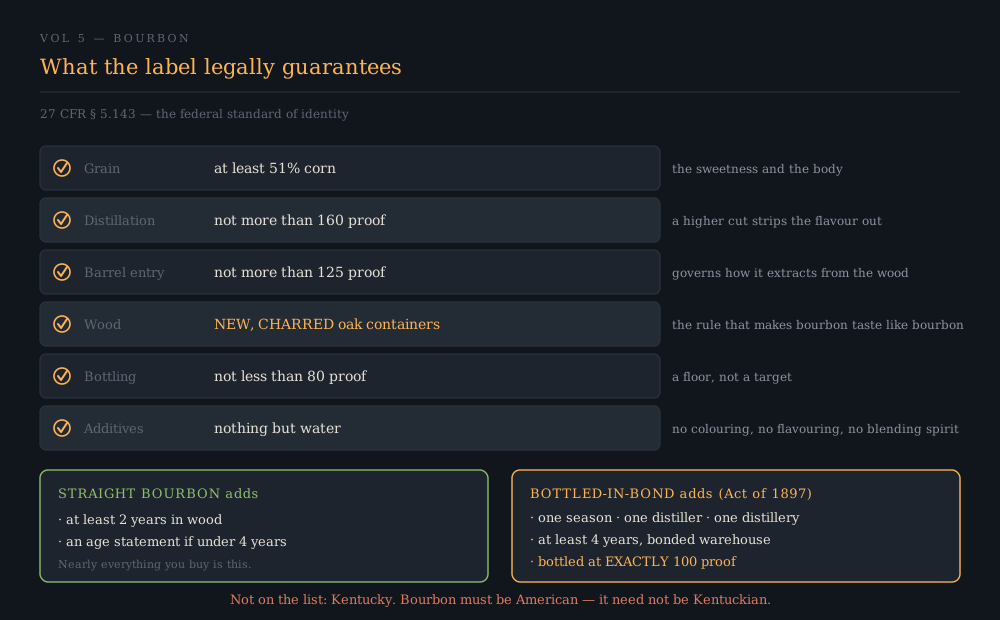
Bourbon is defined in the U.S. federal standards of identity for distilled spirits — 27 CFR § 5.143, renumbered in 2020 from the long-familiar § 5.22. To be labelled bourbon, a whisky must be:
Table 1 — Bourbon is defined in the U.S. federal standards of identity for distilled spirits — 27 CFR § 5.143, renumbered in 2020 from the long-familiar § 5.22. To be labelled bourbon, a whisky must be
| Requirement | The number | What it is actually for |
|---|---|---|
| Grain | At least 51% corn | Corn is the sweetness and the body |
| Distillation proof | Not more than 160 proof (80% ABV) | Keeps flavour congeners in; a higher cut strips them |
| Barrel entry proof | Not more than 125 proof (62.5% ABV) | Governs how the spirit extracts from the wood |
| Wood | New, charred oak containers | The single most distinctive rule; see below |
| Bottling | Not less than 80 proof (40% ABV) | A floor, not a target |
| Additives | Nothing added but water | No colouring, no flavouring, no blending spirit |
Two further terms:
- Straight bourbon adds a minimum of two years in wood, and requires an age statement if the whiskey is under four years old. Nearly everything you will buy is straight bourbon.
- Bottled-in-bond is the strictest common designation, and it comes from the Bottled-in-Bond Act of 1897 — one of the earliest American consumer-protection laws, passed when adulterated and outright fake whiskey was a serious public problem. It requires: the product of one distillation season, by one distiller, at one distillery, aged at least four years in a federally supervised bonded warehouse, and bottled at exactly 100 proof.
🔴 Bourbon does not have to come from Kentucky. It has to be made in the United States. Kentucky bourbon is a separate, additional designation. There is excellent bourbon from Indiana, Tennessee, Texas, New York and Michigan, and the “it isn’t real bourbon unless it’s from Kentucky” line — repeated confidently in a great many bars — is simply false.
🔴 Bourbon has no minimum age. Only straight bourbon does, and only two years at that. A bottle labelled merely “bourbon” with no age statement and no “straight” could in principle be very young indeed.
⭐ “New charred oak” is the rule that makes bourbon taste like bourbon, and it is the one that most surprises people coming from Scotch. Scotch is typically aged in barrels that have already held something else — very often bourbon, because American distillers cannot reuse theirs. Every bourbon barrel gives up its most extractable wood character to one fill, which is why bourbon is sweeter, rounder and more vanilla-and-caramel forward than a whisky matured in a third-fill cask, and why the second-hand bourbon barrel is one of America’s quiet exports.
5.1.3 Tennessee whiskey, which this volume originally skipped
⚠ This section exists because the dive left a hole in it. The volume above says bourbon can come from Tennessee and then never returns to the subject — which quietly writes out the best-selling American whiskey in the world, and the one that turns up in more Old Fashioneds than everything else on this page combined.
Tennessee whiskey meets every requirement for bourbon — 51% corn minimum, new charred oak, the distillation and barrelling proof caps — and then adds one more step, which is why it is labelled separately. Jack Daniel’s own mash bill is 80% corn, 12% malted barley, 8% rye, which puts it in the “traditional / corn-forward” family described below.
⭐ The Lincoln County Process. Before the spirit goes into the barrel it is filtered through about ten feet of sugar maple charcoal. This is not the charcoal filtration used to strip cheap vodka; it is a slow percolation that pulls out some of the heavier congeners and fusel notes and leaves a softer, rounder, slightly sweeter spirit going into the wood. State law requires it for anything labelled Tennessee whiskey, with one grandfathered exemption (Prichard’s).
🔴 So “Jack Daniel’s isn’t bourbon” — the line you will hear confidently in bars — is wrong in the way that matters. It satisfies the federal bourbon standard and could be labelled bourbon; the producer chooses the Tennessee designation instead. The extra step is additive, not disqualifying.
5.1.3.1 Nearest Green
⭐ The man who taught Jack Daniel to distil was an enslaved man named Nathan “Nearest” Green, and he is the first known African-American master distiller in the United States. For most of a century the company’s own telling credited a preacher, Dan Call. A 2016 New York Times piece put Green’s name back in the record; the distillery now recognises him as its first master distiller, and the Tennessee General Assembly formally recognised him in 2019.
This is not a footnote to the Lincoln County Process — the sugar-maple charcoal technique itself descends from West African filtration practice, carried into Tennessee by enslaved distillers. The defining step of the style came from the people who were never credited with it.
5.1.3.2 The line, and what each one does in an Old Fashioned
🔴 The governing rule for this whole table: “smoother” is the wrong axis for a cocktail base. Neat, softness is a virtue. In an Old Fashioned the spirit has to push back against sugar, bitters and 25% dilution, and the bottles engineered to be easiest to drink are the ones that vanish in the glass.
Table 2 — The line, and what each one does in an Old Fashioned
| Expression | Proof | What it is | In an Old Fashioned |
|---|---|---|---|
| Old No. 7 (Black Label) | 80 | The flagship | ⚠ Goes flat. Charcoal-softened and at the legal floor for proof — sugar and bitters roll straight over it |
| Gentleman Jack | 80 | ⭐ Charcoal mellowed twice, before and after the barrel | 🔴 The worst choice in the range, precisely because it is the smoothest. Lovely neat; there is nothing left to hold the drink up |
| Tennessee Rye | 90 | 70% rye mash | A different drink — a rye Old Fashioned. Good, but not this one |
| Sinatra Select | 90 | Matured partly in barrels with grooves cut into the staves for extra wood contact | Works, and it is far too expensive to mix with |
| Single Barrel Select | 94 | One barrel, chosen from the upper floors of the barrelhouses, where it runs hotter and ages harder | ⭐ The sweet spot, and Jeff’s house pour. The first bottling in the range with real backbone |
| Single Barrel Rye | 94 | Single-barrel version of the rye | Excellent in a rye build |
| Bonded | 100 | Bottled-in-Bond: one distiller, one season, one distillery, four years minimum, exactly 100 proof | ⭐⭐ Arguably the best value here. Everything Single Barrel gives you, at a higher proof and a lower price |
| Triple Mash (Bonded) | 100 | A blend of three bonded whiskeys — 60% rye, 20% Tennessee whiskey, 20% American malt | Interesting and genuinely good; the malt reads as a slight nuttiness |
| 10-Year-Old | 97 | Aged Series | Very good, and you are now paying for age you partly cover up |
| 12-Year-Old | 107 | Aged Series | As above, more so |
| 14-Year-Old | 117.6 | Aged Series; the first 14-year Tennessee whiskey in over a century | ⚠ Sip it |
| Single Barrel Barrel Proof | ~125–140 | Uncut, barrel to bottle | ⚠ Rebuild the drink around it — see the proof section below. At 130 proof your stir is doing twice the work |
| Coy Hill High Proof | 137.4–148.3 | 2021 special release from the top ricks of the oldest barrelhouses on Coy Hill, the highest ground on the property | 🔴 Not a mixing whiskey. A curiosity, and a very hot one |
| No. 27 Gold | 80 | Twice mellowed and twice barrelled, finished in maple-wood barrels | ⚠ Same problem as Gentleman Jack, at three times the price |
| Tennessee Honey / Fire / Apple | 70 | Flavoured liqueurs, not whiskey by label | 🔴 No. They are already sweetened; you would be sugaring a sugared spirit |
⭐ The two-bottle answer: Bonded if you want the best Old Fashioned in the range for the money, Single Barrel Select if you want the one Jeff actually pours. Both are 94 proof or better, and that — not the name on the label — is what makes them work here.
Old Fashioned - Best is the house spec, built on Single Barrel with rich demerara and two drops of saline.
5.1.4 Mash bill: the three families
Corn is at least half. What fills the rest — the flavouring grain — sorts bourbon into three families that behave visibly differently in an Old Fashioned.
Traditional / low-rye. Roughly 70–78% corn, 8–15% rye, the balance malted barley. The mainstream. Balanced, caramel-forward, agreeable, and in a cocktail sometimes a little polite.
High-rye. Rye pushed up to roughly 18–35%. Rye brings pepper, mint, dill and a dry spine. This is generally the best family for an Old Fashioned, because the drink adds sugar and the rye pushes back against it. Four Roses’ B mash bill at 35% rye is at the far end of this and is one of the highest-rye bourbon recipes in production.
Wheated. Wheat replaces rye entirely as the flavouring grain. Softer, rounder, bread-and-honey rather than pepper. Wheated bourbons make a gentler, sweeter Old Fashioned that needs less sugar and can take more bitters. Larceny, Maker’s Mark, Weller and Pappy Van Winkle are the well-known ones.
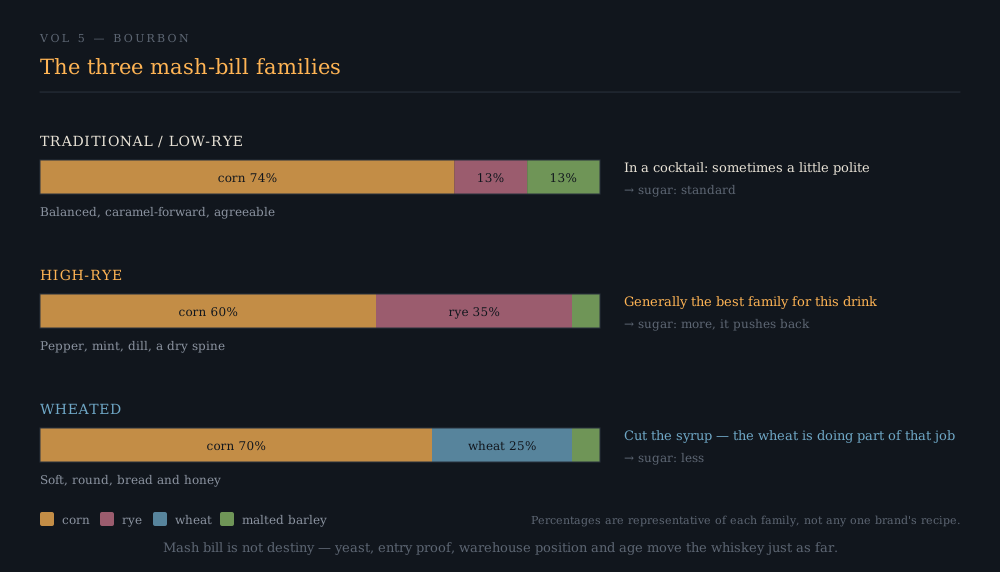
⚠ Do not treat mash bill as destiny. Yeast strain, entry proof, warehouse position and age all move the finished whiskey as far as the grain does. Four Roses proves it in the most direct way available: same two mash bills, five yeasts, and ten recipes that taste unmistakably different from one another.
5.1.5 Proof: the variable that decides the drink
Vol 2 made the general point; here is the bourbon-specific version.
Table 3 — Proof: the variable that decides the drink
| Proof | Typical bottles | In an Old Fashioned |
|---|---|---|
| 80–86 | Entry-level; some premium finishes | Risks being washed out. Use less ice, less water, less sugar |
| 90–94 | The mainstream premium band | The comfortable default; most house specs assume this |
| 100 | Bottled-in-bond; several small batches | The sweet spot. Loud enough to survive dilution, structured enough to carry sugar |
| 110–130 | Barrel proof, single barrel | Excellent, but a different dilution problem — treat water as a real ingredient |
⭐ Bottled-in-bond is the best value proposition on the American whiskey shelf, and it is a cocktail bargain specifically. Four years minimum, single distillery, single season, and exactly 100 proof — for money that usually buys an 80-proof bottle with a better story on the label. In a drink that is about to add sugar, water and bitters, that guaranteed 100 proof is worth more than almost any other thing you could pay for.
5.1.6 Wood and age
Char levels run #1 to #4, set by how long the barrel interior is exposed to flame — commonly cited as roughly 15, 30, 35 and 55 seconds. #4 is “alligator char,” so called for the cracked, scaled appearance of the surface. Deeper char means a thicker layer of active carbon (which strips sulphur compounds and smooths the spirit) over a deeper layer of caramelised wood sugars (which supply vanilla, caramel and toast). Most bourbon uses #3 or #4.
Beneath the char is the toast — a slower, lower-temperature heating that develops different compounds than the flame does. Several producers now specify both, and a heavily toasted, lightly charred barrel makes a noticeably different, more baking-spice-forward whiskey.
Age is not linear and more is not better. American warehouses are hot, the temperature swings are large, and extraction is fast — a Kentucky four-year-old has taken more from its barrel than a Speyside eight-year-old has from its refill cask. Past roughly twelve to fifteen years many bourbons go woody: tannic, drying, bitter in a way that is not the bitters’ kind of bitter. In an Old Fashioned, where you are already adding bitterness, an over-oaked bourbon is actively a liability.
⚠ Warehouse position matters more than the marketing lets on. In a traditional multi-storey rickhouse, the top floors run hot and produce faster, woodier maturation; the bottom floors run cool and slow. “Single barrel” bottlings vary partly for this reason, and it is why two bottles of the same expression can genuinely differ.
5.1.7 The house shortlist
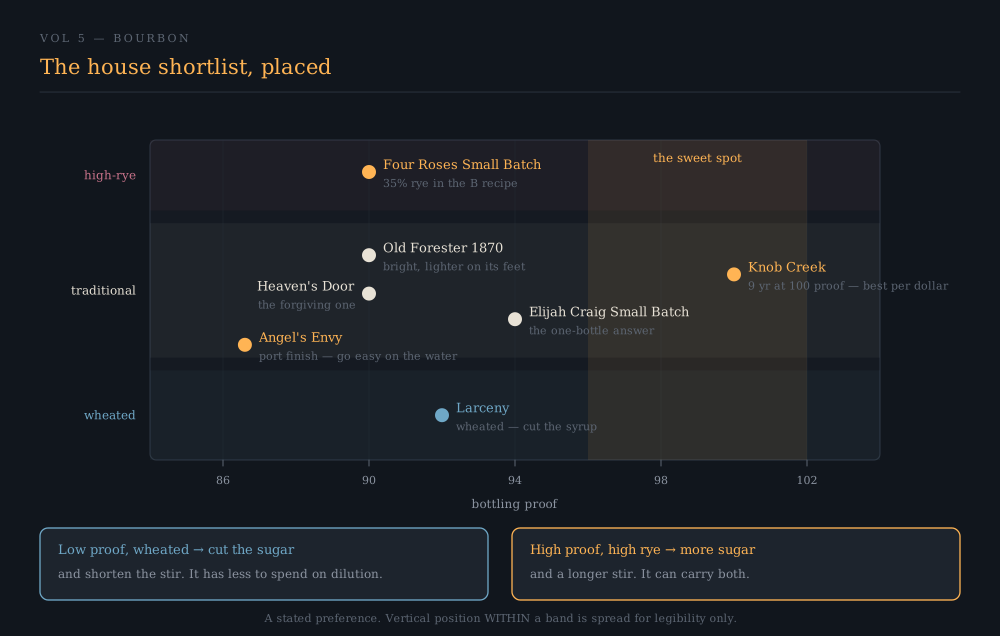
What follows is a stated preference, not a ranking with a methodology behind it. It is recorded here because the rest of this series is written around these bottles, and the reasoning is more useful than the list.
5.1.7.1 The first rank
Angel’s Envy. Kentucky straight bourbon finished in ruby port wine barrels, bottled at 86.6 proof. Founded by Lincoln Henderson, previously master distiller at Brown-Forman, and among the earliest premium American whiskeys to make secondary-barrel finishing its whole identity. The port finish adds dried fruit, a plumminess, and a faint sweetness that reads as depth rather than sugar.
Why it works here: the port character lands exactly where the drink’s sugar already sits, so it deepens the drink rather than fighting it, and it makes the cherry garnish look like a deliberate echo instead of a decoration. The caveat: at 86.6 proof it is on the low side, so go easy on the dilution — a large single cube and a short stir. This is the bottle on the list most easily washed out.
Four Roses Small Batch. 90 proof, and the most intellectually interesting bourbon in general distribution. Four Roses runs two mash bills — B at 60% corn / 35% rye / 5% malted barley, and E at 75% corn / 20% rye / 5% malted barley — across five proprietary yeast strains (V, K, O, Q, F), giving ten distinct recipes. Small Batch is a blend of four of them: OBSK, OESK, OBSO and OESO.
Why it works here: the B mash bill’s 35% rye is a genuinely high-rye backbone, and the blend of yeasts gives a layered fruit-and-spice profile that stays legible under sugar and bitters. It is arguably the best pure-value Old Fashioned bourbon in wide distribution, and it makes a drink with more going on in the middle than its price suggests.
Heaven’s Door. Bob Dylan’s whiskey brand, launched 2018; the flagship straight bourbon is bottled at 90 proof. Like many launches of its generation it began with sourced whiskey while its own Nashville distillery was built, which is ordinary industry practice and worth knowing rather than being scandalised by. The bottles carry Dylan’s own ironwork on the label.
Why it works here: soft, sweet, notably approachable, with a vanilla-and-corn centre that takes to bitters well. It is the most forgiving bottle on the list — the one to build with when you are teaching somebody the drink.
5.1.7.2 The second rank
Elijah Craig Small Batch. Heaven Hill, 94 proof. Carried a 12-year age statement until 2016, when it moved to no age statement — a change that was noticed and complained about loudly, and which does not appear to have hurt the whiskey much. Warm, oaky, brown-sugar-forward.
Why it works here: 94 proof and a distinctly toasty barrel character make a solid, classic, unfussy Old Fashioned. This is the bottle to buy if you want one bourbon on the shelf and you want it to be right most of the time.
Larceny. Heaven Hill’s wheated bourbon, 92 proof, named for John E. Fitzgerald — who, in the brand’s own telling, was a bonded-warehouse agent with a key and a habit of pulling from the best barrels. Soft, bready, honeyed.
Why it works here: it is the wheated slot on the list, and it deserves one. Cut the syrup when you use it — the wheat is already doing part of the sugar’s job, and building it to the standard spec produces a drink that reads sweet. Excellent with black walnut bitters.
Old Forester 1870 Original Batch. 90 proof, part of the Whiskey Row series commemorating stages in the brand’s history; it is built by blending whiskey from several batches drawn from different warehouses and entry proofs, in imitation of the original 1870 practice of blending barrels for consistency. Old Forester’s continuous-production claim through Prohibition — it held a medicinal licence — is one of the genuinely unusual histories in American whiskey.
Why it works here: bright, a little spicy, and lighter on its feet than the rest of the list. Good in warm weather and good when the drink is going to sit.
Knob Creek. Jim Beam’s small batch, 100 proof, with the 9-year age statement restored in 2020 after several years without it. Big, sweet, oaky, unsubtle in the best way.
Why it works here: it is the bottled-in-bond argument in a non-bond bottle — 100 proof and nine years for supermarket money. The most reliably good Old Fashioned per dollar on the list, and the one that stands up best to a big cube, a long sit, and a heavy hand with the bitters.
5.1.8 Michigan
Worth a section, because the state has a real whiskey industry and the local bottle is an easy thing to overlook when the shelf is full of Kentucky.
- Journeyman Distillery (Three Oaks) — organic, certified kosher, and the state’s best-known craft operation; the Featherbone bourbon is the one to start with.
- Grand Traverse Distillery (Traverse City) — grain-to-glass, using Michigan-grown grain.
- Traverse City Whiskey Co. — better known nationally for its cherry products, which is directly relevant to Vol 8’s garnish argument; northern Michigan is cherry country and the whiskey-soaked cherry is a legitimate local answer to the Luxardo question.
- New Holland Brewing / Spirits (Holland) — the Beer Barrel Bourbon, finished in the brewery’s own stout barrels, is an unusual idea executed well.
- Detroit City Distillery, Long Road Distillers (Grand Rapids), Coppercraft (Holland) — all making bourbon or bourbon-adjacent whiskey worth trying.
⚠ Craft bourbon skews young, and young bourbon skews hot and grainy. Small distilleries have small barrels, which extract faster but not identically, and a two- or three-year-old craft bourbon often carries a raw grain note that a big cube and six dashes will not hide. Buy the older expression when there is one, and try it neat before committing it to a drink.
5.1.9 Choosing, in one paragraph
If you want one bottle: Knob Creek or Elijah Craig — 100 and 94 proof respectively, both structurally sound, both inexpensive. If you want the drink to be interesting: Four Roses Small Batch. If you want it to be lush: Angel’s Envy, and go light on the water. If somebody at the table says they do not like whiskey: Heaven’s Door or Larceny, with the syrup cut back. And if you find a bottled-in-bond bourbon you have not tried, buy it — the designation has never once been a bad bet in this drink.
Vol 6 takes the 1806 definition at its word and leaves bourbon entirely.
5.1.10 Sources and further reading
- 27 CFR § 5.143 — Standards of Identity for whisky, including bourbon (renumbered from § 5.22 in the TTB’s 2020 modernisation rule).
- The Bottled-in-Bond Act of 1897, and the TTB’s current bottled-in-bond labelling requirements.
- Four Roses’ published account of its two mash bills and five yeast strains.
- The Distilling deep dive on this site — Vol 1 for the chemistry of fermentation and distillation, Vol 2 for fermentation, and the tier volumes for how the equipment shapes the spirit.
- The Historical Library — period distilling literature, 1669–1893.
- Tennessee Code Ann. § 57-2-106, the 2013 statute defining “Tennessee whiskey” and requiring the Lincoln County Process, with the Prichard’s exemption.
- Jack Daniel’s press room product data — proofs and mash bills for the core, single barrel, Bonded and Aged Series expressions (10-Year 97 proof, 12-Year 107, 14-Year 117.6; Coy Hill High Proof 137.4–148.3).
- Clay Risen, The New York Times, June 2016 — the piece that returned Nathan “Nearest” Green to the record as the man who taught Jack Daniel to distil; the distillery now names him its first master distiller, and the Tennessee General Assembly recognised him in 2019.
Comments (0)