The Old Fashioned · Volume 9
Vol 9 — Ice, Glass, and Technique
Mixed Drinks — the Old Fashioned. Why ice is an ingredient and not equipment, what actually makes ice cloudy and how directional freezing fixes it, cube size as a dilution control, the stir, why this drink is never shaken, and the glass.
9.1.1 Ice is an ingredient
The 1806 definition lists water. In a modern Old Fashioned essentially all of that water arrives by melting, which makes the ice the delivery mechanism for a quarter of the drink. Treating it as equipment — as the thing that makes the drink cold, full stop — is the single most common reason a home Old Fashioned is worse than a bar one, and it is the cheapest thing on this list to fix.
Two quantities matter and they are separable:
- Temperature. How cold the drink gets.
- Dilution. How much water ends up in it.
They are not the same variable, and ice lets you trade between them. That trade is the whole of this volume.
9.1.2 The physics, briefly
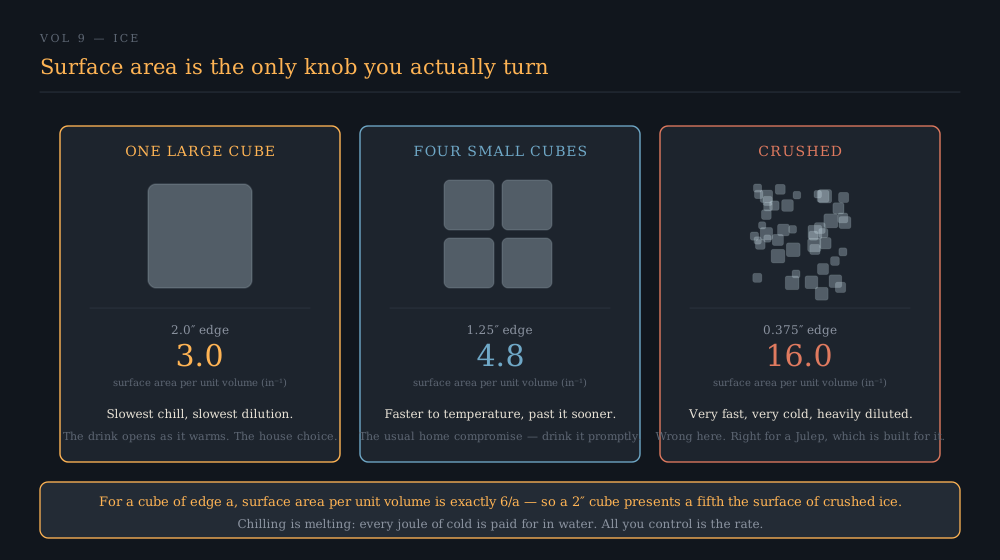
Chilling a drink is overwhelmingly a melting phenomenon, not a conduction one. The energy required to melt ice at 0 °C — its enthalpy of fusion, about 334 joules per gram — is roughly eighty times what it takes to warm the same gram of water by one degree. So almost all the cold your drink receives arrives as ice turning into water, which means:
🔴 Chilling and dilution are physically coupled. You cannot have one without the other. Every joule of chilling is paid for in melted water. The only thing you control is the rate, and you control it with surface area.
- More surface area (small cubes, crushed) → faster heat transfer → faster chill and faster dilution.
- Less surface area (one large cube) → slower chill and slower dilution.
A large cube does not “dilute less” in some absolute sense; it dilutes less per degree of cooling over the time the drink is in your hand. A large cube left in a warm room for an hour will melt just as thoroughly as a small one.
⚠ This is why straight-from-the-freezer ice is a trap. A domestic freezer runs around −18 °C, and ice that cold must first warm to 0 °C before it melts at all. It chills the drink hard while giving up very little water — cold without dilution — and the drinker reads the result as harsh whiskey. Let the ice sit out for a minute, or stir longer than feels necessary. Bars call it tempering, and it is real.
9.1.3 Clear ice
Cloudy ice is not dirty ice. It is ice that froze in the wrong direction.
What happens in a domestic tray: water freezes from every exposed surface inward. Dissolved air, minerals and impurities are excluded from the growing crystal lattice and pushed ahead of the freezing front — which, when the front is closing in from all sides, means they end up concentrated and trapped in the middle. The cloud in the centre of a tray cube is dissolved gas in the form of microscopic bubbles.
Directional freezing fixes it by leaving the impurities somewhere you can throw away. Insulate every side but the top, so the ice grows downward in one direction and pushes everything ahead of it into the last part to freeze — the bottom, which you discard.
The cooler method, which is what most people actually do:
- A small hard-sided cooler, lid off, filled with water.
- Into the freezer, upright, for 18–24 hours — you want it partly frozen, not solid.
- Lift the block out. The top two-thirds is clear; the bottom is cloudy and often still slushy.
- Cut it. A serrated knife scored along a line and tapped with a mallet will split it cleanly, or use a saw. Let the block temper for a few minutes first — ice straight from the freezer is brittle and shatters unpredictably.
- Cut to cube size, store in a bag in the freezer.
🔴 The “boil the water twice” advice is mostly a myth. Boiling does drive off dissolved gases and will marginally improve a tray cube, but it does not address the direction of freezing, which is the actual cause. People who boil their water and still get cloudy cubes have discovered this. Directional freezing works with ordinary tap water.
Silicone moulds and clear-ice makers are the low-effort version — an insulated mould with a reservoir underneath that the cloudy last-to-freeze portion drains into. They work, they produce one or two cubes at a time, and for a household that drinks one or two of these an evening they are entirely sufficient.
⭐ Clear ice is not only cosmetic. Fewer trapped bubbles means a denser, more homogeneous cube, which melts more evenly and slightly more slowly than a cloudy one of the same size, and does not fracture along bubble planes when it meets room-temperature whiskey. The visual is the reason people start; the melt behaviour is the reason they continue.
9.1.4 Cube size
Table 1 — Cube size
| Format | Behaviour | Use |
|---|---|---|
| One large cube (2 in) or sphere | Slowest chill, slowest dilution, drink opens as it warms | The house choice. A spirit-forward drink meant to be sipped over twenty minutes |
| Two medium cubes | Faster to temperature, more dilution | A drink that needs to be right now |
| Standard tray cubes | Fast both ways, dilutes past the target quickly | Acceptable if you drink promptly; the usual home compromise |
| Crushed | Very fast, heavy dilution, very cold | Wrong for this drink. Right for a Julep, which is designed around it |
Sphere versus cube is close to a wash. A sphere has slightly less surface area for a given volume, so it is marginally slower, and it looks superb. A cube sits still in the glass instead of rolling into your teeth. The house preference is the cube, and the reason is the teeth.
⚠ Do not use one large cube with a low-proof base. An 86-proof bourbon (Vol 5) does not have the structure to spend twenty minutes gaining water. Either drink it faster or build it with less syrup.
9.1.5 The stir
Stirring, never shaking. The rule and the reason:
- Shaking aerates. It whips air into the liquid, producing a cloudy drink with a frothy surface and a lighter, spikier texture. That is desirable in a sour, where the citrus and the foam are part of the design. In a spirit-only drink it destroys the weight that Vol 3’s sugar was there to build.
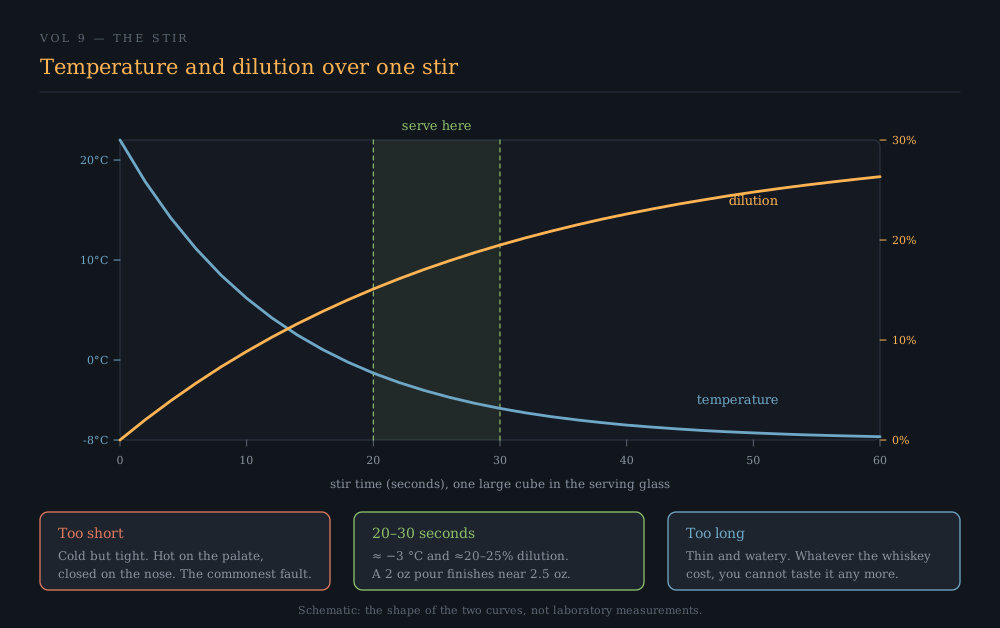
- Shaking over-chills and over-dilutes, fast and without much control — the enormous surface area of shattered ice does in twelve seconds what a stir does in thirty.
- Shaking produces ice shards that continue diluting in the glass.
🔴 The rule, in one line: shake anything with citrus, dairy or egg in it; stir anything that is only spirits, sugar and bitters. The Old Fashioned is the second kind. Every time.
Technique. Bar spoon down the inside wall of the glass, back of the spoon against the glass, and move the spoon around the perimeter rather than churning through the middle — the ice should rotate as a body and the liquid should move with it, quietly. A good stir is nearly silent. A rattling one is chipping the ice.
How long. Building in the serving glass over one large cube: 20–30 seconds, and taste. In a mixing glass with several cubes: 15–20 seconds. These are starting points, not specifications — the variables are the ice temperature, the ice size and the room, and the only honest instruction is taste it before you garnish.
Target: around 20–25% dilution and a serving temperature near −3 to 0 °C (Vol 2). A 2 oz pour finishes at roughly 2.5 oz in the glass.
9.1.6 Build in the glass, or mix and strain?
Both are correct. They produce measurably different drinks.
Build in the serving glass, over the cube it will be served on. Less total dilution, colder for longer, the drink evolves as you sip it. Fewer things to wash. This is the house method for one drink, and the theatre of it — bitters, syrup, whiskey, cube, stir, peel — is part of the pleasure.
Mix in a mixing glass and strain over a fresh large cube. More control over the exact dilution, more repeatable across a round of four, and the served drink starts on ice that has not yet done any work. This is the method for company, and it is what a good bar does.
⚠ What you must not do is mix over ice and then pour ice and all into the glass. You get partly melted, shard-strewn ice that will over-dilute from the moment it lands.
9.1.7 The glass
The Old Fashioned glass — also rocks glass, lowball, tumbler — is a short, wide, heavy-based tumbler of about 6–10 oz. The double Old Fashioned runs 12–16 oz and is what most modern bars actually use, because a 2 in cube does not fit comfortably in anything smaller.
What the shape is for:
- Wide mouth. The aromatics from six dashes of bitters and an expressed peel need somewhere to collect and a wide opening to deliver them. This drink is nosed, not just drunk.
- Heavy base. Historically for muddling; now mostly for the hand, and it is not nothing — the weight is part of why the drink feels the way it does.
- Short. It is a small drink. A tall glass invites topping up with soda, which is a different drink (Vol 7).
Chill the glass if you have the freezer space — five minutes is plenty, and it buys a degree or two of headroom on the dilution budget. ⚠ A frosted glass and a hand-cut clear cube is a slightly comic combination, since the frost is condensation and will run down over the fingers. Chill it, then wipe the outside.
9.1.8 Sources and further reading
- Dave Arnold, Liquid Intelligence (2014) — the standard reference on chilling, dilution and ice, and the source for treating heat of fusion as the governing quantity.
- Camper English’s long-running work on directional freezing, which is where the cooler method entered general bar practice.
- Vol 2 for the dilution target in the context of the other three controls; Vol 5 for why proof sets the dilution budget.
Comments (0)