The Old Fashioned · Volume 3
Vol 3 — Sugar: Cube, Syrup, and the Muddling Wars
Mixed Drinks — the Old Fashioned. This volume covers what sugar is actually doing in the glass, the difference between 1:1 and 2:1 syrup and why it changes two variables at once, the case against the sugar cube, the alternative sugars and where each one belongs, and how to make and keep syrup that does not go cloudy in the fridge.
3.1.1 What the sugar is for
A common mistake — made by people who like the drink as much as by people who do not — is to think of the sugar as the sweetening. It is more useful to think of it as the drink’s suspension.
Three things happen when sugar goes into whiskey and water:
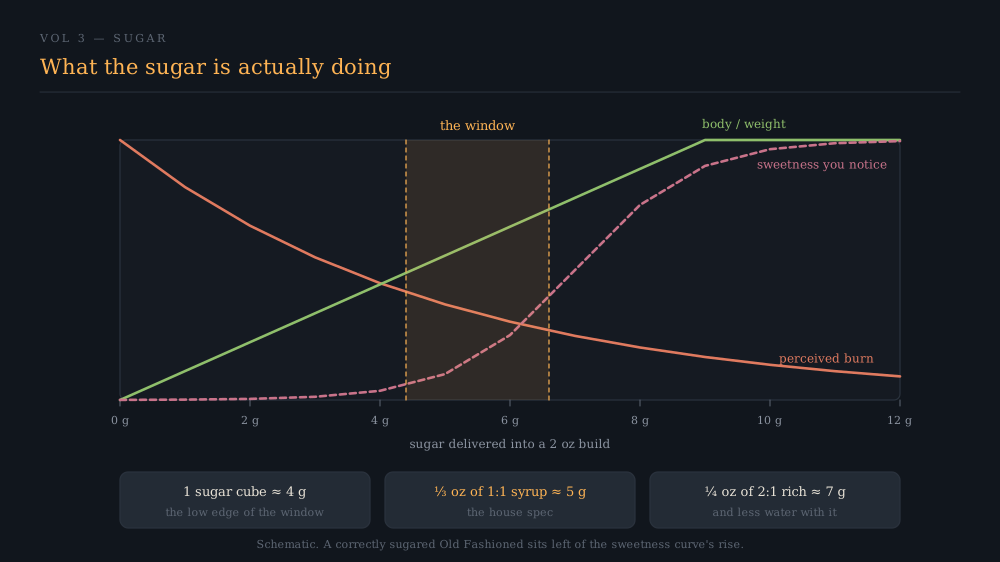
- Perceived ethanol burn drops. Sweetness competitively suppresses the perception of both bitterness and alcoholic heat. The whiskey does not get weaker; it stops announcing its strength first.
- Body appears. Dissolved sucrose raises viscosity slightly, and the mouth reads that as weight and length. This is a large part of why a well-made Old Fashioned feels expensive and an under-sugared one feels thin.
- The bitters get something to work against. Bitterness with nothing opposing it is austere. Bitterness against sugar is complexity. This is the axis Vol 2 called the balance control, and it is why the sugar and the bitters must be adjusted together.
⭐ A correctly sugared Old Fashioned does not taste sweet. If sweetness is a flavour you notice, the drink is over-sugared or under-bittered — those are different problems with the same symptom, and Vol 2’s failure table separates them.
3.1.2 The case against the sugar cube
The sugar cube is the traditional method, it is in the IBA specification, and it is on the front of a great many menus. It is also, in practice, the single most common cause of a bad Old Fashioned.
The technique is: cube in the glass, bitters onto the cube, muddle until the cube breaks down, then whiskey and ice. The failure is that sucrose dissolves slowly in cold, low-water, high-ethanol liquid — which is an exact description of an Old Fashioned. Muddling breaks the cube into grains; it does not dissolve them. The grains then sit at the bottom of the glass, and the drink is over-sweet at the last sip and under-sweet for the first three.
🔴 The grainy sweet sludge at the bottom of a bar Old Fashioned is not tradition. It is an unfinished drink. A syrup has already done the dissolving in hot water, where sucrose dissolves readily, and delivers a known quantity of sugar evenly distributed from the first sip.
⚠ The honest counter-argument, and it is a real one: a cube muddled with bitters is what the 19th-century bar did, and a bar working at speed with a house that expects it can do it well — muddle thoroughly, add a splash of water first to help it along, and taste. The objection here is not to history; it is to the version of the technique that stops before the sugar is gone. The historical method with the dissolution step skipped is not the historical method.
A sugar cube is about 4 g, or roughly a level teaspoon. For comparison, 1/3 oz of 1:1 simple syrup carries about 5 g of sugar, and 0.25 oz of 2:1 rich syrup about 6 g. The cube is at the low end of the modern range — which is worth knowing before assuming the syrup version is the sweeter one.
3.1.3 Syrup: 1:1 versus 2:1, and the trap in between
Two standard concentrations, and they are not interchangeable at equal volume.
Table 1 — Syrup: 1:1 versus 2:1, and the trap in between
| Syrup | Ratio | Sugar per 1/3 oz | Water per 1/3 oz | Keeps (fridge) |
|---|---|---|---|---|
| Simple, 1:1 | 1 part sugar : 1 part water by volume | ~5 g | ~5 ml | 3–4 weeks |
| Rich / “gomme,” 2:1 | 2 parts sugar : 1 part water | ~7 g | ~2.5 ml | 5–6 months |
🔴 Switching between them changes two knobs in the same direction at once. Same volume of 2:1 instead of 1:1 means more sugar and less pre-ice water — sweeter and hotter, simultaneously. This is the mechanism behind the most confusing kitchen failure in the whole drink: a recipe that was balanced last month tastes wrong today, and nothing about the whiskey or the ice has changed. Somebody refilled the syrup bottle at a different ratio.
By volume or by weight? Bar recipes say “by volume” and home recipes often mean “by weight,” and they are not the same: granulated sugar is roughly 0.85 g per ml, so a 1:1-by-volume syrup is about 46% sugar by mass while 1:1-by-weight is 50%. The difference is small enough to ignore for one drink and large enough to matter when you are chasing a spec across a batch. Pick one convention and write it on the bottle.
⭐ Why 2:1 keeps so much longer is not a preservative effect of the sugar being “more” in a vague sense — it is water activity. A rich syrup is concentrated enough that there is not enough free water for most spoilage organisms to work with. A 1:1 syrup is dilute enough to be a growth medium and will eventually throw a cloud or a mould raft in the fridge. Either can be stabilised with a small measure of neutral spirit — about half an ounce of vodka per cup — which is the standard bar trick and costs nothing in flavour.
3.1.3.1 Making it
Hot method, for either ratio: heat the water, add the sugar off a full boil, stir until the liquid goes clear rather than merely thin, cool, bottle. Do not boil hard and do not reduce — the ratio you measured is the ratio you want, and boiling water away changes it.
Cold method, 1:1 only: sugar and room-temperature water in a sealed jar, shaken every few minutes for about a quarter of an hour. Slower, and it produces a marginally cleaner, brighter syrup because nothing has been cooked. For 2:1 the cold method is impractical — that much sucrose wants heat.
⚠ Cloudiness is the tell. A syrup that goes from clear to hazy in the fridge has started to spoil, whatever it smells like. Discard it. This is the one place in the whole drink with an actual food-safety dimension, and it is trivially avoided by making small batches often.
The house recipes for both, with quantities: Simple Syrup · Cinnamon Simple Syrup
🔴 Homemade, always. This is a stated preference and it is a strong one. Bottled bar syrup is usually high-fructose corn syrup with a preservative and frequently a “natural flavour” that reads as vaguely caramel; it is thicker than it should be, it tastes of the bottle, and it is the cheapest possible false economy in a drink where sugar is one of four ingredients. Sugar and water take four minutes.

3.1.4 The other sugars
White sugar is the default because it is the transparent option: it contributes sweetness and body and nothing else, leaving the whiskey and the bitters to supply all the flavour. Every alternative below trades some of that transparency for character, and the trade is worth making on purpose rather than by accident.
Demerara and turbinado. Partially refined cane sugars with residual molasses. A demerara syrup adds a light toffee note that sits directly on top of barrel-aged whiskey — it is the most natural alternative to white for this drink, and for a high-rye bourbon it is arguably better. Muscovado goes further and starts to taste of molasses in its own right.
Maple. Genuine maple syrup is not a sugar syrup — it is roughly two-thirds sugar with a full flavour of its own, and it is already at about the concentration of a 2:1 rich syrup. Use it at rich-syrup volumes, not at 1:1 volumes. It makes an excellent autumn Old Fashioned and a poor year-round default, because it dominates. Grade A Dark or Very Dark carries further than the pale grades.
Honey. Needs thinning — a 1:1 honey-and-hot-water “honey syrup” is the workable form, because neat honey will not incorporate in a cold drink. Floral and assertive; better with Irish whiskey or a wheated bourbon than with a high-rye.
Agave. The standard sweetener for the agave-based variations in Vol 7, where it belongs. In a bourbon Old Fashioned it is a neutral-to-vegetal presence that adds little.
Brown sugar. Works, but dissolves badly and is best made into a syrup rather than used dry. At that point demerara syrup is the better version of the same idea.
⭐ A useful discipline: change one sugar at a time and keep the rest of the build fixed. The sugar is the cheapest variable to experiment with and the easiest to over-attribute — a drink made with maple syrup, a different whiskey and different bitters teaches you nothing about maple.
3.1.5 Body without sweetness: gum arabic and glycerine
Everything above treats sugar as the source of the drink’s body. That was never the whole story, and this volume had a gap in it.
The 19th-century bar did not use plain simple syrup. It used gum syrup.
3.1.5.1 Gomme, and why Jerry Thomas keeps calling for it
Gum syrup — gomme sirop — is a rich syrup with gum arabic dissolved in it: a natural resin tapped from acacia trees, food-safe, essentially flavourless, and a superb emulsifier and texturiser. It was the standard bar sweetener for most of the 1800s, which is why it appears throughout Thomas’s 1862 book and why the Improved Whiskey Cocktail calls for it rather than for simple syrup.
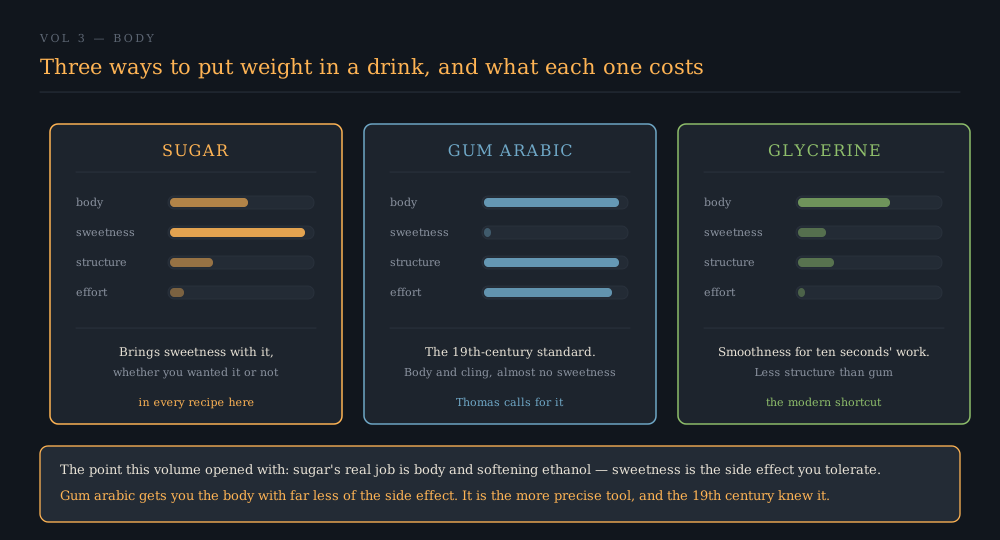
What it adds is weight, not sweetness. A gomme-sweetened drink has a silkiness and a slight viscous cling that plain syrup cannot produce at the same sugar level, and — the part that matters for an Old Fashioned — it rounds off the burn of a strong spirit without adding more sugar to do it.
⭐ This is the point that reframes the volume. Vol 3 opened by saying sugar’s real job is to soften ethanol and add body, and that sweetness is the side effect you tolerate to get them. Gum arabic gets you the body with much less of the side effect. It is the more precise tool, and the 19th century knew it.
Making it: hydrate powdered gum arabic in an equal weight of warm water — it takes hours and it is tedious — then stir that into a 2:1 rich syrup at roughly a fifth of the syrup’s volume. Recipe: Gomme Syrup (Gum Arabic).
⚠ It is genuinely slow. Gum arabic does not want to dissolve, and rushing it gives a gritty, cloudy syrup. This is an overnight job, which is most of why bars stopped doing it.
3.1.5.2 Glycerine, the modern shortcut
Glycerine — glycerol — does much of the same job in about ten seconds. It is a sugar alcohol, naturally present in fermented drinks, colourless, odourless, miscible in both water and alcohol, faintly sweet, and viscous. Stir a small quantity into simple syrup and the syrup gains body; drinks made from it gain mouthfeel and a softer edge.
It is not a modern gimmick either — the Oxford Companion to Spirits & Cocktails records glycerine in commercial liqueur and flavouring production since the 19th century. It is simply that it arrived in the trade rather than on the back bar.
How much: published guidance clusters around 1–2% by volume, which is roughly half a teaspoon to a teaspoon per cup of finished syrup.
⭐ The house syrup runs at about 4%, which is double the top of that range and deliberate. One tablespoon of glycerine into a syrup built from 1 cup of water and 1 cup of sugar — about 19 g into roughly 1.5 cups of finished syrup — is what gives it its body. So treat 1–2% as a cautious starting point and 4% as a demonstrated working figure, rather than treating the published range as a ceiling.
⚠ Still start low if you are new to it. The effect is textural and cumulative, and past a certain point a syrup goes from silky to faintly slick and cloying — a defect that is hard to name and easy to notice. It is easier to add glycerine to the next batch than to take it out of this one.
Which to use, honestly:
Table 2 — Which to use, honestly:
| Gum arabic (gomme) | Glycerine | |
|---|---|---|
| Effort | Overnight hydration, fussy | Stir it in |
| Texture | Richer, more structure, real cling | Smooth, softer, less structural |
| Emulsifying | Yes — genuinely useful in citrus drinks | No |
| Flavour of its own | Essentially none | Faintly sweet |
| Historical claim | The 19th-century standard | 19th-century trade use, not bar use |
| Shelf life help | Some | Yes — hygroscopic, holds moisture |
🔴 Two practical notes on glycerine. Buy food-grade / USP vegetable glycerine — the label matters, and it is cheap and widely sold. And be aware that glycerine is a laxative in quantity; at a teaspoon per cup of syrup, spread across many drinks, that is not a concern, but it is a reason not to treat “more is better” as a strategy.
The recipe — the house simple syrup already has the glycerine in it: Simple Syrup.
3.1.6 Muddling: what it is for, and what it is not
Muddling is mechanical extraction — crushing something to release its juice or its oils. It has two legitimate uses in this drink and one illegitimate one.
- Legitimate: breaking down a sugar cube. Discussed above. If you use a cube, you must muddle it, and you must keep going.
- Legitimate: expressing oils from a piece of citrus peel into sugar, which is the oleo saccharum technique — peel and sugar left together so the sugar’s hygroscopy draws the oil out of the zest. It makes an intensely orange syrup and it is genuinely excellent here. It is also, historically, the foundation of punch, which is why it turns up again in the Clarified Milk Punch dive.
- 🔴 Illegitimate: crushing orange flesh and a cherry into the bottom of the glass. This is the muddled-fruit style, and Vol 8 gives it a full and fair hearing because in Wisconsin it is not a mistake but a tradition. In a spirit-forward Old Fashioned it is simply a different drink: the fruit juice adds acid and sugar the build was not designed for, the pith adds a coarse bitterness unlike the bitters’, and the result is cloudy.
Oleo saccharum, briefly, because it is the best-kept secret in this volume: peel three or four oranges in wide strips with no pith, toss the peel with about half a cup of sugar, seal it, and leave it at room temperature for several hours to overnight. The sugar draws out the oil and dissolves in it, and what you pour off is a thick, almost fluorescent orange syrup. Used at rich-syrup volumes, it makes an Old Fashioned that needs no orange garnish at all.
3.1.7 Getting the quantity right
Start at the house spec and move in one direction:
- 1/3 oz of 1:1 with a 90-proof bourbon and six dashes of bitters is the reference point.
- Raise the sugar if the drink reads hot or austere, or if you have gone up in proof.
- Lower it if sweetness is a flavour you can name, and check the bitters before you do — under-bittered reads as over-sugared.
- Re-balance whenever the whiskey changes. A wheated bourbon at 92 proof and a high-rye at 100 want different sugar, and the difference is bigger than most people expect.
⚠ Taste the drink before the garnish goes on. Once the orange oil is on the surface, the nose changes enough that judging the sugar becomes noticeably harder. Taste at the end of the stir, adjust, then garnish.
3.1.8 Sources and further reading
- Dave Arnold, Liquid Intelligence (2014) — on sweetness, viscosity and the perception of ethanol burn.
- David Wondrich, Punch (2010) — the definitive account of oleo saccharum and of sugar’s role in the punch tradition that preceded the cocktail.
- Vol 2 for how sugar interacts with the other three controls; Vol 8 for the muddled-fruit question in full.
- House syrup recipes: Simple Syrup, Cinnamon Simple Syrup.
Comments (0)