The Old Fashioned · Volume 1
Vol 1 — Before It Was Old: The 1806 Definition and the Birth of a Name
Mixed Drinks — the Old Fashioned. This volume covers where the word cocktail came from, the first printed definition of it, why that definition describes exactly this drink, how the name “Old Fashioned” arrived some seventy years later as a complaint rather than a recipe, and which parts of the popular origin story do not survive contact with the record.
1.1.1 The drink that is a definition
Almost every classic cocktail is a recipe: a named list of ingredients in fixed proportion. The Old Fashioned is not. It is a category that outlived its category — the surviving specimen of what the word cocktail meant before the word meant everything.
That is an unusual thing for a drink to be, and it explains most of what is otherwise strange about it. It explains why the name sounds like a grumble rather than a noun. It explains why there is no single authoritative recipe and never has been. It explains why two people can both make one correctly and produce visibly different drinks. And it explains why the arguments about it are unusually heated: an argument about an Old Fashioned is not really an argument about a drink, it is an argument about what a cocktail is.
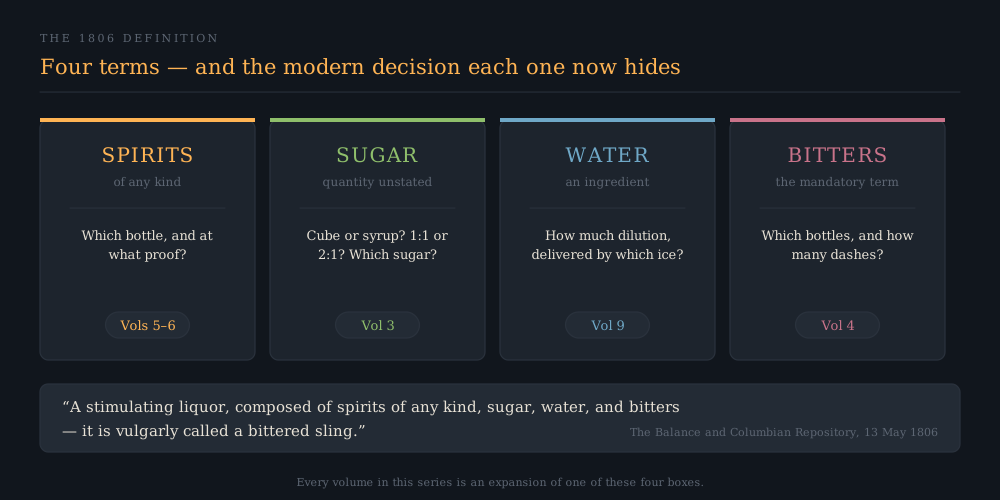
Everything downstream in this series — the sugar, the bitters, the whiskey, the garnish, the ice — is a variable in a four-term definition that was written down in a small New York newspaper in 1806 and has never been improved on.
1.1.2 What “cocktail” meant in 1806
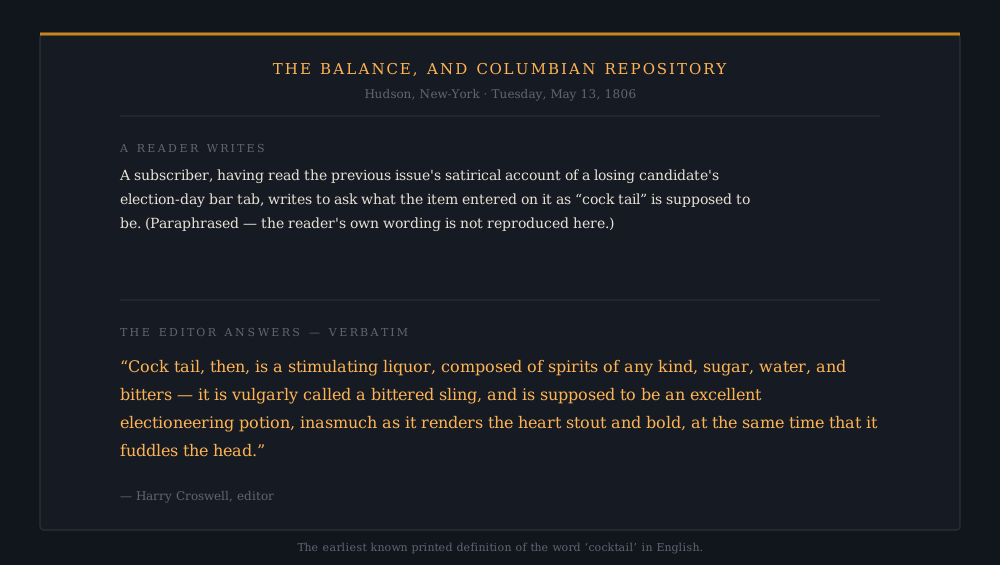
On 13 May 1806, The Balance and Columbian Repository, a Federalist paper published in Hudson, New York, ran a reader’s letter. The previous issue had printed a satirical account of a lost election in which a candidate’s tab included, among the rum and brandy and gin, a quantity of something called “cock tail.” A reader wrote in to ask what on earth that was.
The editor — Harry Croswell, better known to history as the defendant in the New York criminal-libel case argued by Alexander Hamilton — answered in print:
Cock tail, then, is a stimulating liquor, composed of spirits of any kind, sugar, water, and bitters — it is vulgarly called a bittered sling, and is supposed to be an excellent electioneering potion, inasmuch as it renders the heart stout and bold, at the same time that it fuddles the head.
That is the whole of it. Four ingredients, one joke about politics, and the earliest known definition of the word in English. Read it as a specification and it is startlingly complete:
Table 1 — That is the whole of it. Four ingredients, one joke about politics, and the earliest known definition of the word in English. Read it as a specification and it is startlingly complete
| Term | What it actually specifies | Volume |
|---|---|---|
| Spirits of any kind | The base is a variable, not a constant. Whiskey is not named. | Vols 5–6 |
| Sugar | A sweetener, quantity unstated — the drink’s balance control. | Vol 3 |
| Water | Dilution is an ingredient, not an accident of the ice. | Vol 9 |
| Bitters | The mandatory term. Without it the drink is a sling, not a cocktail. | Vol 4 |
The fourth term is the load-bearing one. Croswell is explicit that a cocktail is a bittered sling — a sling being spirit, sugar and water, which is to say a toddy. Bitters are the entire difference between the two categories. This matters more than it sounds: it means that a whiskey, sugar and water with no bitters in it is, by the founding definition of the word, not a cocktail at all. It is a sling. The bitters are not a garnish or a seasoning; they are the thing that makes the category exist.
⭐ Note what the definition does not say. It does not say whiskey. It does not say bourbon. It does not say rye, or Kentucky, or America. It says spirits of any kind — and every national and regional variation covered in Vol 7, including the ones purists dismiss, is operating strictly inside the original terms.
1.1.2.1 The word itself, and the stories about it
The etymology of cocktail is genuinely unsettled, and the confidence with which bars retail one explanation or another is not earned by the evidence. The candidates, with the honest verdict on each:
- Docked horses. A horse with a docked tail — one that stood up like a cock’s — was called cock-tailed, and the term was used for a horse of mixed or uncertain breeding, particularly one dressed up to look better than it was. A “cocktailed” horse is an adulterated horse; an adulterated drink taking the same name is linguistically unremarkable. This is the strongest candidate, and the one most etymologists favour.
- Cock ale. A genuine 17th-century English preparation — ale infused with, among other things, a cock. Documented, and plausibly in the background of the word, but no direct line to the 1806 sense.
- The dregs. “Cock tailings” — the last of a barrel drawn off from the cock (tap) and sold cheap. Attractive, thinly evidenced.
- 🔴 The coquetier. The story that Antoine Amédée Peychaud, a New Orleans apothecary, served brandy toddies in a French egg cup — a coquetier — and that American tongues turned the word into “cocktail.” This cannot be right. The word is in print in New York in 1806, in a context that assumes readers have at least heard of it; Peychaud’s New Orleans pharmacy belongs to the 1830s. The story is a good story and it is roughly thirty years too late. It survives because it is told in New Orleans, where it flatters the city, and because nobody checks the dates.
The honest position: the word most likely comes from horses, the drink certainly comes from the sling, and anybody who tells you the question is settled is telling you a story rather than the record.
1.1.3 The bittered sling in practice, 1806–1860
For the first half of the 19th century, “a cocktail” meant this drink and essentially nothing else. It was a morning drink — the American habit of an eye-opener before work is well attested and frequently complained about by visiting Europeans — and it was made with whatever was to hand: gin (Dutch genever, not the London dry that would come later), brandy, rum, applejack, and increasingly, in the interior, whiskey.
The equipment was minimal because the drink is minimal. A small tumbler, a bar spoon, loaf sugar broken up, a bottle of bitters, and a lump of ice if the establishment had an ice house. Ice is the one input that changed the drink most in this period, and Vol 9 takes that up properly: before Frederic Tudor’s ice trade made cold reliable and cheap in American cities, the “water” of the 1806 definition was simply water.
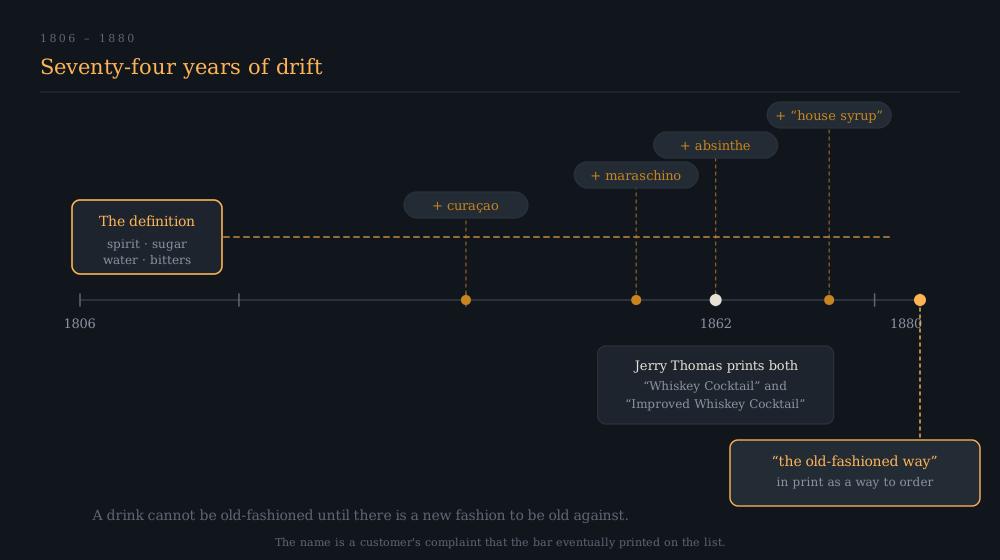
By the 1850s the cocktail had escaped the definition. Bartenders were building reputations, and reputations are not built on four ingredients. Curaçao appeared. Then maraschino. Then absinthe. Then a small pour of anything the house was proud of.
1.1.4 Jerry Thomas and the fancy turn
Jerry Thomas published How to Mix Drinks; or, The Bon-Vivant’s Companion in 1862 — the first cocktail book printed in America, and the document that turns bartending from a trade into a literature. It is the hinge of this story.
Thomas gives a Whiskey Cocktail: whiskey, gum syrup, bitters, a little water, a twist of lemon peel. That is the 1806 definition with the spirit pinned down and a piece of citrus added. Nothing about it would confuse a modern drinker.
Immediately alongside it he gives the Improved Whiskey Cocktail — the same drink plus a dash of maraschino and a dash of absinthe. And he gives Fancy cocktails, which are the plain ones served in fine glassware with the rim dressed. The vocabulary is the tell: by 1862 you already need adjectives to distinguish the elaborated version from the plain one, which means the elaborated version is common enough to need distinguishing.
⭐ This is the moment the Old Fashioned becomes possible. A drink cannot be old-fashioned until there is a new fashion to be old against. Thomas documents the new fashion arriving.
1.1.5 The name arrives as a complaint
By the late 1870s, in American bars, ordering “a whiskey cocktail” got you whatever the bartender’s whiskey cocktail happened to be — and increasingly that meant something with a liqueur in it. Drinkers who wanted the plain 1806 article had to say so.
They said so by asking for it the old-fashioned way.
That is the whole origin of the name. It is not a proper noun that somebody coined; it is an adjective that customers used, over and over, until bars gave up and printed it on the list. Printed references to an “old-fashioned cocktail” appear in American newspapers by around 1880 — that is, as a phrase already in circulation, being reported rather than introduced.
🔴 The Pendennis Club story does not survive this. The popular account holds that the drink was invented in the 1880s at the Pendennis Club in Louisville by a bartender honouring Colonel James E. Pepper, a bourbon distiller, who then carried it to the bar of the Waldorf-Astoria in New York. It is repeated on menus, on brand websites, and in a great many otherwise careful books.
It cannot be an invention story, for three plain reasons:
- The drink is documented decades earlier — it is the 1806 definition, and Thomas prints it in 1862 under a different name.
- The phrase is in print at about the same time as the club and in cities other than Louisville, which is not how a single-club invention propagates in the 1880s.
- The story itself surfaces late, in the 20th century, in promotional contexts. A drink invented in a named room in a named city in the 1880s ought to leave a contemporaneous trace. This one does not.
What the Pendennis Club may well have done is popularise the drink among a particular set of people, and what Colonel Pepper may well have done is carry the order to New York. Both are ordinary and plausible. Neither is invention. The dive’s position: treat Pendennis as marketing that hardened into history, and treat 1806 as the birth certificate.
⚠ A fair caution in the other direction. Absence of a contemporaneous trace is not proof of nothing happening, and 19th-century bar practice is under-documented generally. The claim being rejected here is specifically invention — the strong claim, the one printed on bottles. “The Pendennis Club served a well-regarded one” is unobjectionable and probably true.
1.1.6 Prohibition, decline, and the fruit
Prohibition (1920–1933) did not kill the Old Fashioned; it killed the profession that made it. Thirteen years is long enough to lose a generation of bartenders, and the American bar that reopened in 1934 had to be taught its own trade again out of books, by men who had learned it in Havana and London and Paris or had not learned it at all.
The drink that came back was recognisably the same and was made worse over the following forty years by a series of individually small decisions:
- Muddled fruit became standard. An orange slice and a cherry, crushed in the glass with the sugar, producing a sweet pink slurry at the bottom.
- Soda water became standard in much of the country, converting a spirit-forward drink into a long one.
- Bottled sour mix and bar syrup replaced sugar and bitters as the balance mechanism in the worst cases, and the bitters were sometimes dropped entirely — at which point, by Croswell’s definition, the drink stopped being a cocktail.
- Whiskey itself declined in quality and in fashion; the American whiskey industry’s low point in the 1970s and 1980s left a lot of thin, young, heavily filtered bourbon on the back bar.
🔴 The story that muddled fruit was invented to hide bad Prohibition whiskey is a just-so story. It is repeated everywhere, it is satisfying, and it is not well supported. Fruit garnish in cocktails predates Prohibition; a great deal of the sweetening and lengthening that damaged the drink happened well after Repeal, when whiskey quality was no longer the problem; and the trend toward sweeter, longer, less bitter drinks in mid-century America is general — it hits every classic, not just this one. Blame the sweet tooth of the 1950s and 60s, and the collapse of bartending as a career, before blaming bootleggers.
The muddled-fruit style is treated in full, and treated fairly, in Vol 8 — because in one part of the country it is not a decline at all but a distinct and defensible tradition, and Wisconsin will have something to say about it in Vol 7.
1.1.7 The revival, and why it took
The recovery began in the 1990s and 2000s with a small number of bars that went back to the 19th-century books — Jerry Thomas among them — and rebuilt the classics from the source. The reissue and scholarly excavation of that literature, above all David Wondrich’s Imbibe! (2007), gave the movement a documentary spine. Where earlier revivals had been about atmosphere, this one was about texts.
The Old Fashioned benefited more than almost any other drink from that, for a reason worth stating plainly: it is the drink where knowing the history changes the recipe. Knowing that a Negroni is equal parts does not make a better Negroni. Knowing that the Old Fashioned is the 1806 definition tells you immediately to stop crushing fruit into it, to put the bitters back, to treat dilution as an ingredient, and to let the whiskey be the loudest thing in the glass.
Popular culture supplied the rest of the lift — Mad Men from 2007 put one in a lead character’s hand every week, and the drink’s sales curve is visible in the trade data from about that point. Since then it has sat at or near the top of Drinks International’s annual poll of the world’s best-selling classic cocktails for most of a decade, generally trading first place with the Negroni and the Margarita.
⭐ The irony is worth keeping. A drink named as an old man’s complaint about newfangled bartending was rescued by the most self-consciously scholarly generation of bartenders in history — who then had a fresh argument about what “correct” means. That argument is the rest of this series.
1.1.8 Where this series goes
Table 2 — Where this series goes
| Vol | Subject | The question it answers |
|---|---|---|
| 2 | Anatomy | What are the four parts for, and what does each one control? |
| 3 | Sugar | Cube, syrup, or something else — and why homemade wins on more than taste |
| 4 | Bitters | Why the mandatory ingredient is the one most people treat as optional |
| 5 | The Spirit I — bourbon | What the label legally guarantees, and which bottles suit this drink |
| 6 | The Spirit II | Rye, brandy, rum, agave — the “spirits of any kind” clause, honoured |
| 7 | Regional variations | Wisconsin, New Orleans, Oaxaca, Japan, and why they are all legitimate |
| 8 | Garnish | Cherries, citrus oil, and the muddled-fruit schism |
| 9 | Ice, glass, technique | Dilution as an ingredient; clear ice; stir, never shake |
| 10 | Smoke | What smoke actually does, and the four ways to put it in the glass |
The recipes themselves are not here. They live with the rest of the kitchen collection, where they sync to a phone at the bar: the cocktail shelf on the Food site.
1.1.9 Sources and further reading
- The Balance and Columbian Repository, Hudson, N.Y., 13 May 1806 — the first printed definition of “cock tail.”
- Jerry Thomas, How to Mix Drinks; or, The Bon-Vivant’s Companion (New York, 1862), and the revised edition of 1876.
- David Wondrich, Imbibe! (2007; revised 2015) — the standard modern scholarly treatment of Thomas and of 19th-century American bar practice.
- Drinks International, The World’s Best-Selling Classic Cocktails, annual bartender survey.
- The Historical Library on this site holds the period distilling and brewing literature that sits behind Vols 5–6: the catalogue.
Comments (0)