The Old Fashioned · Volume 6
Vol 6 — The Spirit II: Rye, Brandy, and Everything Else
Mixed Drinks — the Old Fashioned. The 1806 definition says spirits of any kind. This volume takes it at its word: rye and what happened to it, Canadian whisky and the label that misleads, brandy and applejack, rum, agave, genever — the historical gin version — and how the build changes for each.
6.1.1 Honouring the clause
Vol 1’s definition contains four words that are routinely ignored by people who quote the rest of it: spirits of any kind. Croswell was not being vague; he was describing a category that took whatever was behind the bar. Whiskey’s monopoly on the Old Fashioned is a 20th-century American development, not a founding condition.
That has a practical consequence. Every variation in this volume is inside the definition, and the correct response to a rum Old Fashioned is not “that isn’t an Old Fashioned” but “what did the sugar and bitters get changed to?” — because they should have been.
6.1.2 Rye: the one that was there first
American rye whiskey carries a standard of identity that parallels bourbon’s exactly, with one substitution: at least 51% rye in place of at least 51% corn. Same 160-proof distillation ceiling, same 125-proof barrel entry, same new charred oak, same 80-proof floor. Straight rye adds the two-year minimum.
Rye, not bourbon, was the dominant American whiskey before Prohibition. Pennsylvania — Monongahela rye — and Maryland were the great producing regions, and the styles were distinct: Monongahela ryes ran very high in rye, Maryland’s were softer and often sweeter. Prohibition destroyed both. Where Kentucky rebuilt after Repeal, the mid-Atlantic rye industry effectively did not, and by the 1980s American rye was down to a handful of nearly forgotten labels kept alive for a small and ageing market.
The revival is one of the genuine successes of the modern cocktail movement — a wholesale reconstruction of a category, driven by bartenders working from 19th-century books and discovering that half the recipes wanted a spirit nobody was making any more.
In an Old Fashioned, rye is drier, peppery, faintly minty or dill-like, with a harder edge than bourbon and less corn sweetness underneath. It is arguably the more historically apt choice and it is certainly the more assertive one. Build it with slightly more sugar than a bourbon of the same proof — the drink has less inherent sweetness to work with.
🔴 A great many differently branded ryes are the same whiskey. MGP of Indiana, in Lawrenceburg, distils an enormously popular 95% rye / 5% malted barley mash and sells it in bulk. It has appeared, at various times and under various contracts, behind a long list of brands that do not distil anything themselves. This is not fraud — sourcing is legal, normal, and often produces excellent whiskey — but it does mean that a shelf of eight “craft” ryes may be three distilleries wearing eight labels, and that comparative tasting notes written as though they were eight different products are describing packaging. Read the back label for “distilled in Indiana.”
6.1.3 Canadian whisky, and a label that misleads
Canadian whisky is regulated under Canada’s Food and Drug Regulations: mashed, distilled and aged in Canada, at least three years in small wood (barrels of 700 litres or less), bottled at not less than 40% ABV, and permitted to contain a small proportion — up to about 9.09%, one part in eleven — of other spirits or wine.
🔴 “Canadian rye” need not contain much rye, or any. In Canada, Canadian whisky, rye whisky and Canadian rye whisky are legally interchangeable names for the same product, a historical hangover from a period when rye genuinely was the flavouring grain. A bottle labelled “rye” on a Canadian shelf tells you where it was made, not what it was made from. American rye’s 51% rule has no Canadian equivalent. This trips up a lot of people building a “rye Old Fashioned” from the wrong bottle and wondering why it tastes thin.
Canadian whisky’s characteristic construction is blending a nearly neutral base whisky with a small proportion of intensely flavourful flavouring whisky, which produces the smooth, light style the category is known for. In an Old Fashioned that lightness is a liability at standard proportions — cut the water hard, cut the sugar, and choose one of the assertive modern bottles (Lot 40, Alberta Premium, Pike Creek) rather than a mainstream blend.
6.1.4 Brandy
Brandy is not an outlier here; it is a founding member. Thomas’s 1862 book gives a Brandy Cocktail alongside the whiskey one, and in the mid-19th-century American bar brandy was at least as usual a base as whiskey. It has a whole region of the modern United States to itself, and Vol 7 covers Wisconsin properly.
Cognac. Grape brandy from the Charente, double-distilled in copper pot stills, aged in French oak. VS is young, VSOP older, XO older still. A VSOP cognac Old Fashioned is a lovely, rounder, dried-fruit-and-floral version of the drink; use demerara syrup and a heavier hand on the orange bitters, and consider Peychaud’s for part of the aromatic.
Armagnac. Gascony, generally column-distilled once to a lower proof, rustic and more assertive than cognac. Better in this drink than its price ranking against cognac would suggest.
American brandy. Korbel is the name that matters, for reasons entirely to do with Wisconsin. Also Christian Brothers, and a growing craft category — Copper & Kings in Louisville is the interesting one.
Applejack. Apple brandy, and a genuinely American spirit: Laird’s, in New Jersey, holds licence number one and traces commercial production to 1780, which makes it the oldest licensed distillery in the country. ⚠ Read the label carefully — Laird’s Applejack is a blend of apple brandy and neutral spirit; Laird’s Bottled-in-Bond Straight Apple Brandy at 100 proof is the one you want for a cocktail, and it is a spectacular Old Fashioned: orchard fruit, real structure, and a natural affinity for the orange peel.
6.1.5 Rum
An aged-rum Old Fashioned is one of the best variations in this volume and one of the least ordered.
- Demerara rum (Guyana; El Dorado and the various independent bottlings from the historic wooden stills) is the natural fit — molasses-rich, brown-sugar-deep, made for demerara syrup and a heavy dose of Angostura, which is itself a Caribbean product.
- Aged Jamaican rum brings hogo — the funky, overripe-fruit ester character from long fermentation. Smith & Cross at 114 proof makes a fierce, wonderful drink. Treat the dilution seriously.
- Rhum agricole (Martinique, from cane juice rather than molasses) is grassy and vegetal; it makes a drink that is unmistakably not a whiskey Old Fashioned and is worth the trip.
- Spanish-style light aged rums are generally too polite for the format.
Build: demerara or a lightly spiced syrup, Angostura, and consider a dash of allspice bitters. Orange peel still works; a lime peel is the interesting alternative.
6.1.6 Agave
The Oaxaca Old Fashioned is the most successful new variation the drink has produced, and it has an author and a date: Phil Ward, at Death & Co in New York, around 2007. The build is reposado tequila with a smaller measure of mezcal — roughly three to one — agave nectar in place of syrup, Angostura, and a flamed orange peel.
What makes it work is that the mezcal is used as a seasoning rather than a base. A full pour of mezcal makes a smoky drink; a quarter-pour makes a tequila drink with smoke in the nose, which is a much more interesting thing and a direct cousin of what Vol 10 does with a smoking gun.
⚠ Agave nectar is sweeter and thicker than 1:1 syrup — use it at rich-syrup volumes or thin it. And ⚠ mezcal varies enormously; an artisanal espadín and a mass-market smoke-flavoured product are not substitutes.
6.1.7 Genever, and the historical gin version
This is the one that surprises people who think of the Old Fashioned as inherently American and inherently whiskey.
Jerry Thomas’s revised 1876 edition contains a drink called the “Old-Fashioned Holland Gin Cocktail.” It is among the earliest printed uses of “old-fashioned” as a drink name — and the spirit it names is Holland gin: genever, the malty, pot-distilled Dutch ancestor of gin, much closer to a light whiskey than to London dry.
⭐ The name “Old Fashioned,” in its earliest printed drink title, is attached to gin. That is a genuinely useful corrective to the idea that the drink is a bourbon institution with some heretical variants. It was a format, and the format took whatever was in the well.
A genever Old Fashioned is excellent: malty, faintly sweet, herbal, and unlike anything else in this volume. Bols Genever is the widely available bottle. London dry gin, by contrast, makes a drink that is coherent but strange — the juniper and the aromatic bitters fight rather than combine, and it wants orange bitters alone.
6.1.8 The rest of the world’s whiskey
Irish. Typically triple-distilled and lighter; single pot still Irish (Redbreast, Green Spot) has an oiliness and a spice that carry well. Honey syrup suits it better than white sugar.
Scotch. Contentious, and the objection is mostly tribal. A blended Scotch makes a decent, light Old Fashioned. A lightly peated Highland makes a good one. A heavily peated Islay makes a Smoky Old Fashioned that is a real drink with real partisans — and note that this is smoke arriving through the spirit rather than through the technique, which makes it an instructive comparison against Vol 10.
⚠ Sherried Scotch plus sugar plus Angostura is easy to over-sweeten. Cut the syrup by a third before you start.
Japanese. Precision blending, generally clean and elegant, often with a delicacy that the format can bury; the better move is usually a higher-proof or more heavily sherried expression. 🔴 Read the label. Until recently, “Japanese whisky” was not a protected term in Japan, and a substantial quantity of bulk whisky distilled elsewhere was bottled and labelled as Japanese. The Japan Spirits & Liqueurs Makers Association introduced voluntary labelling standards in 2021 requiring fermentation, distillation and maturation in Japan for the designation — but they are voluntary, and the market still contains product that predates or ignores them.
Indian and Taiwanese. Amrut, Paul John, Kavalan — tropical maturation, fast extraction, big flavour. They make excellent, intense Old Fashioneds and they are under-explored in this application.
6.1.9 Changing the spirit itself: infusion and washing
Everything above swaps one bottle for another. There is a second axis: keep the bottle and change what is in it.
An infused base is not the same as adding a modifier. A dash of orange bitters sits on top of the whiskey; an orange-infused bourbon is the whiskey. In a four-ingredient drink with nowhere to hide, that difference is larger than it sounds — and it is why an infused Old Fashioned reads as one coherent thing rather than a drink with something added to it.
6.1.9.1 Five ways to go faster — and one that changes what you get
Extraction is limited by mass transfer: the liquid touching the botanical saturates locally, and everything then waits on that saturated layer being carried away. Each method below attacks that limit differently, and the difference is not only time — pressure and fat reach compounds the others never touch.
Table 1 — Five ways to go faster — and one that changes what you get
| Mechanism | What it physically does | Rough time |
|---|---|---|
| Steeping | Diffusion alone. The slowest possible route | Hours to weeks |
| Agitation | Forced convection — continuously renews the boundary layer | Tens of minutes to hours |
| Heat | Raises diffusion rate and solubility together | 1–2 hours at ~57 °C |
| Cavitation | Collapsing bubbles physically batter the botanical | 12–25 minutes |
| Pressure | Forces liquid into the cells; release ruptures them | ~1 minute |
| Fat-washing | A different axis — a solvent for fat-soluble compounds | Overnight |
⭐ Agitation is the one people underrate, and it is the same physics as the swirl in Vol 10’s flask method. Sitting in a jar is passive transfer at an undisturbed surface. Stirring never lets that surface settle. It is the cheapest large improvement available.
🔴 Pressure is the only one that changes the extraction profile rather than the rate. N₂O at pressure drives liquid into the botanical’s cell structure, and the sudden release boils it back out, tearing cells open. That reaches compounds no amount of stirring will. It is Dave Arnold’s rapid-infusion technique, documented in Liquid Intelligence, and it is why a one-minute pressure infusion is not simply “a fast steep.”

6.1.9.2 What suits what
- Citrus peel, soft fruit, delicate herbs — steep or stir, cold. These give up their aromatics readily and heat drives the good part off.
- Hard spice — cinnamon, clove, star anise, vanilla, coffee, cacao — heat or cavitation. Dense, and they reward the extra energy.
- Toasted oak, nuts, dried fruit — heat or pressure.
- Anything where you want the fat-soluble character — bacon, brown butter, toasted nut oil — is a fat-wash, not an infusion. See Bourbon, Fat-Washed.
⚠ Faster is not automatically better. Pressure and cavitation extract indiscriminately, so they will pull tannin and bitterness out of pith, stems and seeds as readily as aroma out of zest. For a delicate infusion, the slow method is often the better-tasting one — the fast methods earn their place on dense ingredients and on a schedule.
6.1.9.3 The house kit — and what it can already do
Two of the useful mechanisms are already on the bench here, both bought for other jobs:
The magnetic stir plate — with heat, and a set of stir bars, kept for making yeast starters. A stir bar in a flask of spirit and botanicals gives continuous, unattended agitation for as long as you like. It is the whole “motorised infuser” product category, with better capacity, using glassware already in the cupboard.
The sous vide circulator — a Joule. A jar or bag at around 57 °C for 1–2 hours is the standard rapid-infusion-by-heat method, and it is written up in the modern bar literature.
⭐ And the two combine. A gently warmed vessel on the stir plate is heat and agitation at once — which is most of what an expensive infuser does, from equipment bought for brewing.
🔴 SAFETY, and this one is not boilerplate. Ethanol boils at 78 °C and its vapour is flammable. A stir plate’s hotplate can go far above that.
- Use the stir function and leave the heat off, or barely on. Agitation is doing the work; heat is a small bonus and a large risk.
- Never leave an open vessel of spirit on a heated plate unattended, and keep it away from any flame — including the torch from Vol 10 and the smoking-gun work.
- For heat, use the sous vide instead. A water bath cannot exceed its set point, which is exactly the property you want when the liquid is 40% ethanol.
- ⚠ Do not seal a rigid jar tight in a sous vide bath. Warm alcohol expands and off-gasses; use a bag, or a lid set on loosely.
- ⚠ An ultrasonic bath takes a sealed jar standing IN the water — never spirit in the tank itself.
6.1.9.4 Infusing for this drink specifically
Keep it to one idea. The Old Fashioned has four terms and no room for a base doing three things at once. Orange peel. Or toasted oak. Or cinnamon. Or coffee. Not all four.
And re-balance afterwards — an infusion usually adds perceived sweetness or bitterness, so the syrup and the bitters need a look (Vols 2–4). An infused base is a changed base, and the drink was balanced around the old one.
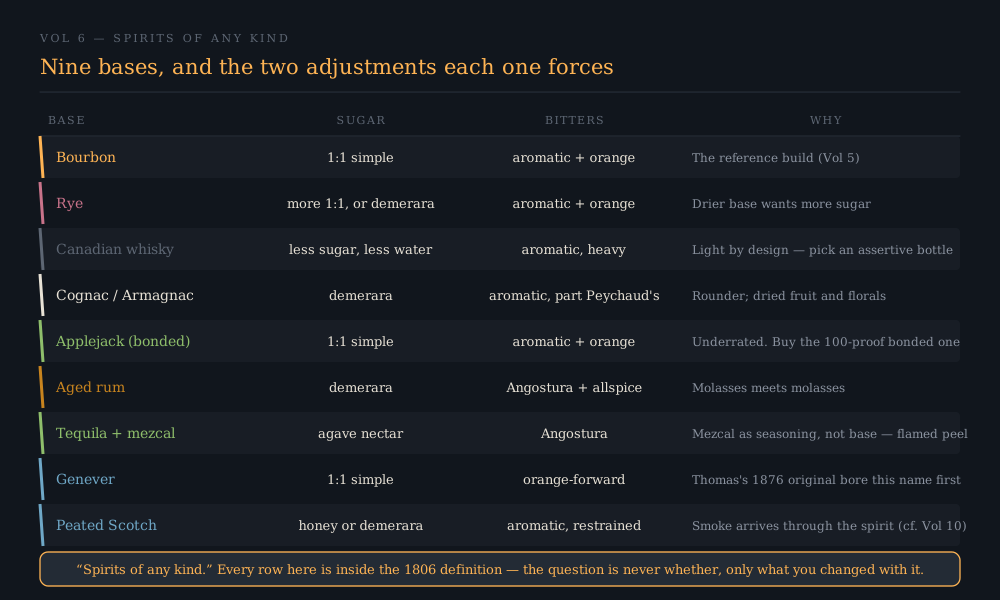
6.1.10 A summary table
Table 2 — A summary table
| Base | Sugar | Bitters | Note |
|---|---|---|---|
| Bourbon | 1:1 simple | Aromatic + orange | The reference build (Vol 5) |
| Rye | Slightly more 1:1, or demerara | Aromatic + orange | Drier base wants more sugar |
| Canadian | Less water, less sugar | Aromatic, heavy | Choose an assertive bottle |
| Cognac | Demerara | Aromatic + orange, or part Peychaud’s | Rounder, dried fruit |
| Applejack (bonded) | 1:1 simple | Aromatic + orange | Underrated; buy the bonded one |
| Aged rum | Demerara | Angostura + allspice | Natural fit; try Demerara rum first |
| Tequila + mezcal | Agave nectar | Angostura | Flamed orange peel (Oaxaca) |
| Genever | 1:1 simple | Orange-forward | The 1876 original |
| Peated Scotch | Honey or demerara | Aromatic, restrained | Smoke through the spirit |
6.1.11 Sources and further reading
- 27 CFR § 5.143 — standards of identity for rye and the other American whisky types.
- Canada, Food and Drug Regulations, Division 2 (Alcoholic Beverages) — the Canadian whisky standard, including the interchangeability of “rye.”
- Jerry Thomas, How to Mix Drinks, revised edition (1876) — the Old-Fashioned Holland Gin Cocktail.
- Japan Spirits & Liqueurs Makers Association, labelling standards for Japanese whisky (2021).
- The Distilling deep dive on this site for how each of these spirits is actually produced.
Comments (0)