The Old Fashioned · Volume 7
Vol 7 — Regional and National Variations
Mixed Drinks — the Old Fashioned. Wisconsin’s brandy old fashioned in full and taken seriously, New Orleans and the Sazerac line, Kentucky and the Louisville muddle, Oaxaca, Japan, and the general question of what “authentic” can possibly mean for a drink that was defined as a variable in the first place.
7.1.1 Why the variations are not deviations
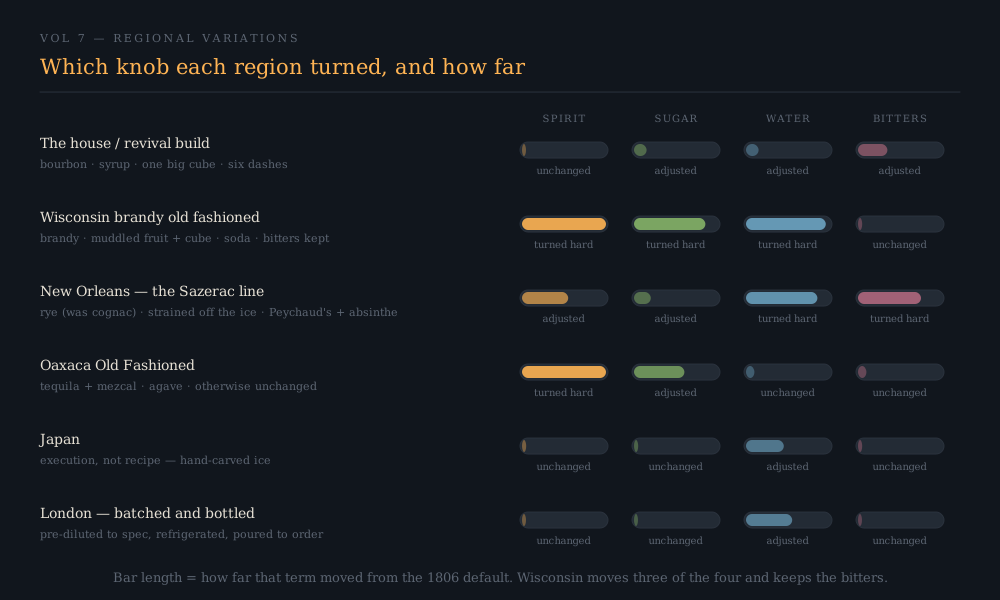
A format with four free variables will localise. That is what formats do. The Old Fashioned’s regional versions are not corruptions of a fixed recipe — there has never been a fixed recipe — they are what happens when four knobs meet local supply, local taste and a century of habit.
This volume takes them on their own terms. The house preference is stated plainly elsewhere in this series and is not withdrawn; but a preference is not a standard, and the most common failure in cocktail writing is to mistake one for the other. Wisconsin in particular gets treated as a joke by people who have never had a good one, which is both unfair and — more to the point — historically illiterate.
7.1.2 Wisconsin: the brandy old fashioned
In Wisconsin, “an old fashioned” means brandy, and if you want whiskey you say so. The drink is a genuine regional institution — it belongs to the state’s supper club culture, it is ordered by the hundreds of thousands every Friday night, and it is made to a shape that is stable across the whole state and unlike anything else in this volume.
The build:
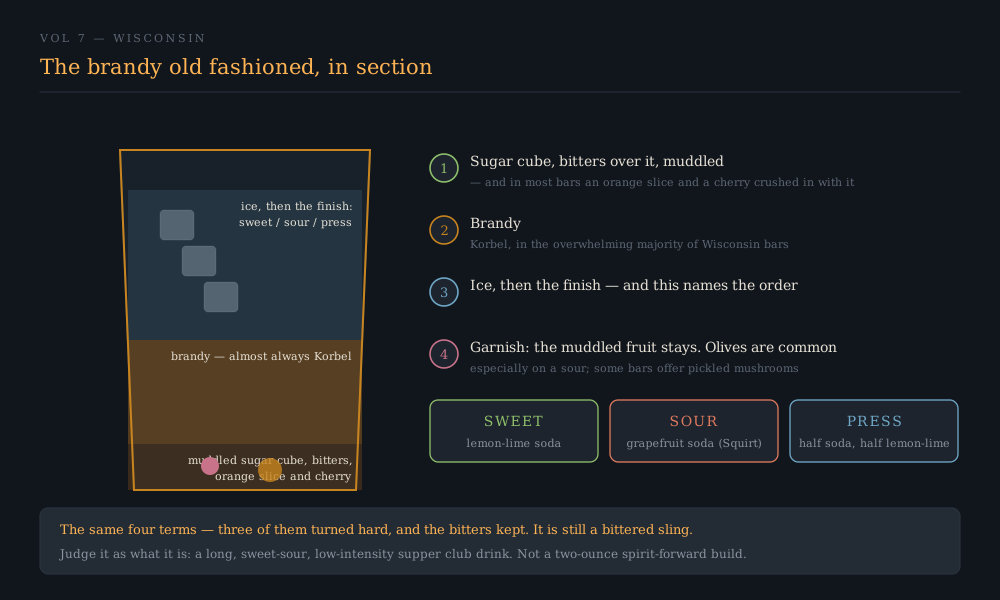
- Sugar cube in the glass, bitters over it, muddle — with, in most bars, an orange slice and a maraschino cherry crushed in along with it.
- Brandy — almost always Korbel, a California grape brandy.
- Ice, then topped with one of three things, and the order at the bar is made by naming it:
- Sweet — lemon-lime soda (Sprite, 7Up)
- Sour — a grapefruit soda, usually Squirt, or sour mix
- Press — half soda water, half lemon-lime; the middle path, and the most common serious order
- Garnish: the muddled fruit stays in, and — distinctively — olives are common, especially on a sour. Some bars offer pickled mushrooms, pickled Brussels sprouts, or a whole skewer.
So: the same four terms, three of them turned hard. The base changed from whiskey to brandy, the sugar arrived partly as fruit and partly as soda, and the water became carbonated and doubled in volume. The bitters, notably, stayed. It is still a bittered sling.
⭐ It is a long drink, and it should be judged as one. Comparing a Wisconsin brandy old fashioned press to a two-ounce spirit-forward bourbon build is comparing a shandy to a barleywine. Judged as what it is — a refreshing, sweet-sour, low-intensity supper club drink meant to be had before a fish fry and possibly followed by another — a good one is very good, and a bad one is bad in the ordinary way that any drink made carelessly is bad.
7.1.2.1 Why brandy
The story everybody tells: Wisconsinites encountered Korbel brandy at the 1893 World’s Columbian Exposition in Chicago, loved it, and took the habit home.
🔴 This is folklore. It is repeated by bars, by tourism boards and by the brandy producer, and there is no contemporaneous documentation of a 1893 conversion event. The Exposition explanation has the shape of an origin myth: a single dramatic moment, a named world’s fair, a tidy cause. Real consumption patterns almost never work that way.
The better explanation is duller and better supported, and has three strands:
- German immigration. Wisconsin received an exceptionally large German-speaking population in the 19th century, and Weinbrand — grape brandy — was an ordinary part of that drinking culture in a way it was not for Anglo-American settlers.
- Post-Prohibition distribution. When legal liquor returned in 1934, the brands that got shelf space were the ones with distributors, and regional distribution deals in that period produced durable state-level preferences across many products, not just this one.
- Supper clubs. Wisconsin’s supper club institution — a specific kind of family-owned rural restaurant with a bar at the front — standardised the drink and then held it stable for eighty years. Once a whole state’s bars make a drink the same way, the drink stops evolving.
Korbel’s Wisconsin share is genuinely remarkable and is the fact underneath the folklore: the state consistently accounts for a share of the brand’s US sales out of all proportion to its population. That much is real. The 1893 conversion is a story told about it afterward.
⚠ “The official state cocktail” is stated more confidently than the record supports. Bills to designate it have been introduced in the Wisconsin legislature more than once. Treat it as the state’s unquestioned signature drink, which it is, rather than as a statutory designation.
7.1.3 New Orleans: the Sazerac line
New Orleans’s contribution is not a variant Old Fashioned but a parallel evolution of the same 1806 format, and the family resemblance is unmistakable once you line them up.
The Sazerac is: rye whiskey (historically cognac, and the switch is usually attributed to the phylloxera devastation of French vineyards in the late 19th century), Peychaud’s bitters, sugar, and an absinthe rinse — the absinthe swirled in a chilled glass and discarded, leaving only aroma. It is served without ice in the glass, stirred with ice and strained, and finished with a lemon peel that is expressed and, by strict local practice, not dropped in.
Set against the house Old Fashioned:
Table 1 — Set against the house Old Fashioned
| Old Fashioned | Sazerac | |
|---|---|---|
| Base | Bourbon | Rye (originally cognac) |
| Sugar | Syrup | Sugar or syrup |
| Bitters | Angostura + orange | Peychaud’s |
| Water | From a large cube, in the glass | Stirred in, then strained off the ice |
| Aromatic finish | Expressed orange oil | Absinthe rinse, expressed lemon |
⭐ The Sazerac is the same four terms with the water handled completely differently. Serving it without ice means the dilution is fixed at the moment of straining and does not move — a colder, more concentrated, less forgiving drink that must be made right and drunk promptly. It is a genuinely different design philosophy applied to the same definition.
The Sazerac was designated the official cocktail of New Orleans by the Louisiana legislature in 2008, which is the kind of designation Wisconsin’s drink is often wrongly said to have.
A New Orleans-inflected Old Fashioned — substituting Peychaud’s for part of the Angostura and adding an absinthe rinse to the glass — is one of the best experiments in this series and takes about ten extra seconds.
7.1.4 Kentucky and the American muddle
Louisville has the Pendennis Club story (dismantled in Vol 1) and it also has, in a great many of its bars, a muddled orange and cherry — the same technique the spirit-forward school objects to. The muddled version is not a Wisconsin peculiarity; it is the mainstream American bar practice of roughly 1940–2000, and it is still ordinary in the state that claims the drink.
The modern Kentucky “correct” build — bourbon, syrup or a well-muddled cube, Angostura, expressed orange, single large cube — is a revival position, not an unbroken tradition. It is the position this series holds, and it is worth being honest that it is a recovered practice rather than an inherited one.
The Kentucky Derby’s drink is the Mint Julep, not the Old Fashioned, which is a useful reminder that the state’s cocktail identity is not as monolithic as the marketing suggests.
7.1.5 Oaxaca
Covered in Vol 6 as a base substitution; it belongs here too as a place, because the drink is named for one. Phil Ward’s Oaxaca Old Fashioned, created at Death & Co in New York around 2007, is reposado tequila with a smaller measure of mezcal, agave nectar, Angostura, and a flamed orange peel.
⚠ Note what it is and is not. It is a New York bartender’s homage to Oaxacan spirits, not a drink that came out of Oaxaca. That is not a criticism — it is an excellent drink and the naming is affectionate rather than appropriative — but a dive that spends Vol 1 dismantling one origin myth should be careful not to install another.
7.1.6 Japan
Japan’s contribution is not a recipe; it is a standard of execution, and it has changed bars worldwide.
The Japanese bartending tradition treats the drink as a craft object: hand-carved ice, cut from a large clear block with a saw and shaped with a knife into a sphere or a diamond; glassware chilled and handled deliberately; measurement exact; the stir counted. A Japanese Old Fashioned is usually built spirit-forward, minimally garnished, and served with an ice sphere that is a genuinely impressive piece of hand work.
⭐ The technical influence has travelled further than the drinks have. Clear ice, the large-format cube, ice moulds and presses, and the whole modern Western obsession with the physics of chilling (Vol 9) descend substantially from Japanese bar practice.
⚠ The “hard shake” is not relevant here. It is a shaking technique for shaken drinks, and the Old Fashioned is stirred. It comes up in this context constantly and it should not.
7.1.7 Elsewhere, briefly
- The United Kingdom. The modern London bar’s contribution is batching and pre-dilution — an Old Fashioned mixed, diluted to spec, bottled and refrigerated, then poured over ice to order. Consistent, fast, and slightly joyless; the theatre is gone, but the drink is reliably correct.
- Italy. Not a variant so much as a neighbouring tradition. The Italian bitter-and-vermouth family (Negroni, Boulevardier) shares the Old Fashioned’s structural logic — spirit plus sweetness plus bitterness — and an amaro split, a quarter-ounce standing in for part of the syrup, makes a very good Italian-inflected Old Fashioned.
- Australia and New Zealand. Strong modern cocktail cultures with a taste for fat-washing — infusing a spirit with a fat (butter, bacon, coconut oil), then freezing and filtering it out, leaving flavour and a heavier texture. A brown-butter-washed bourbon Old Fashioned is a genuinely good idea and belongs to this school.
7.1.8 What “authentic” can mean here
A drink defined in 1806 as spirit of any kind, sugar, water and bitters cannot have a single authentic form, and this volume has been an argument to that effect. What it can have is coherence — a build where the four terms are in a deliberate relationship to each other and to the bottle in hand.
🔴 The versions worth objecting to are not the regional ones. They are the incoherent ones: the drink with no bitters (a sling, by definition); the drink with an undissolved sugar cube (unfinished, Vol 3); the drink drowned in soda with a sweet base and no acid or bitterness to answer it. Those fail on their own terms, in any region.
Wisconsin’s drink is coherent. New Orleans’s is coherent. The house spec is coherent. They are three answers to the same four-term question, and only one of them is a preference.
7.1.9 Sources and further reading
- Wisconsin supper club literature — Ron Faiola’s Wisconsin Supper Clubs: An Old Fashioned Experience (2013) is the accessible account of the institution the drink belongs to.
- David Wondrich, Imbibe! (2007) — for the Sazerac’s cognac-to-rye transition and the 19th-century New Orleans bar.
- City of New Orleans / Louisiana Legislature, 2008 designation of the Sazerac as the city’s official cocktail.
- Death & Co, Death & Co: Modern Classic Cocktails (2014) — for the Oaxaca Old Fashioned as its creators published it.
- Vol 6 for the base substitutions in technical detail; Vol 8 for the muddled-fruit question on its own.
Comments (0)