The Old Fashioned · Volume 10
Vol 10 — Smoke
Mixed Drinks — the Old Fashioned. What smoke actually is chemically, which woods do what, the five ways to put smoke in the glass ranked by how much control each gives, how long is too long, and where the theatre ends and the flavour begins.
10.1.1 Smoke is a variation, not a requirement
The smoked Old Fashioned arrived with the cocktail revival, spread through social media faster than almost any other bar technique, and is now available in a great many places that do it badly. None of that makes it a gimmick. A well-smoked Old Fashioned is a genuinely different and genuinely good drink, and the technique has an honest basis: barrel-aged whiskey already carries charred-oak phenols, and adding more of the same family of compounds in the glass is a coherent idea rather than an arbitrary one.
The house position is that smoked and unsmoked are both correct, and that the unsmoked build is the reference — Vols 2 through 9 are calibrated to it. Smoke is a variation applied to a drink that already works.
10.1.2 What smoke actually is
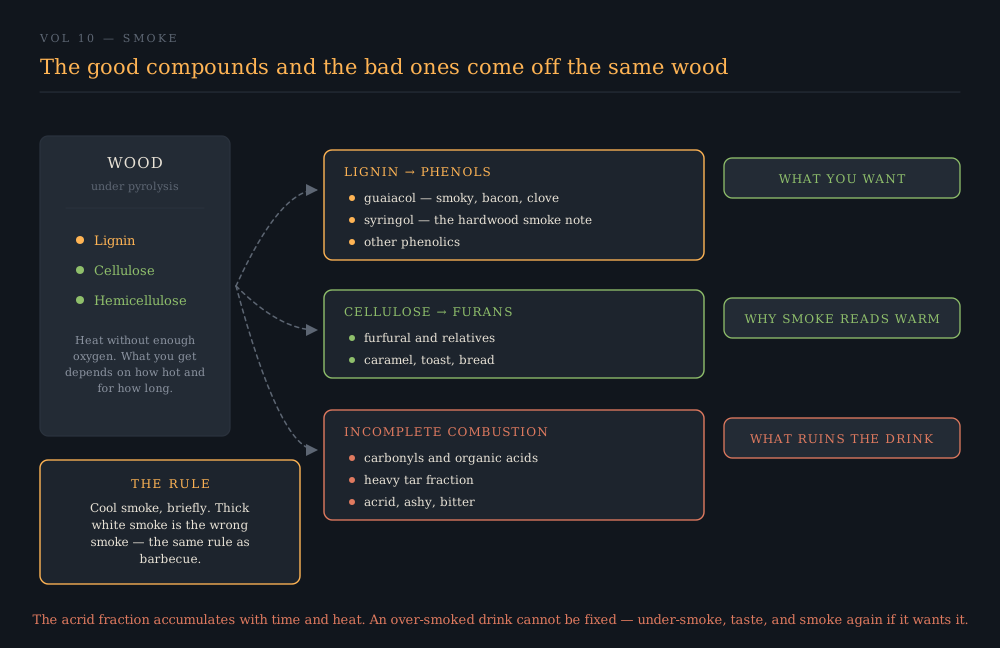
Wood smoke is the product of pyrolysis — wood decomposing under heat with limited oxygen — and its three structural polymers break down into three different families of compounds.
- Lignin → the phenols, which are the smoky ones. Guaiacol carries what most people mean by “smoky,” with a bacon-and-clove edge; syringol is the other major contributor and comes preferentially from hardwoods. These are the compounds you actually want.
- Cellulose and hemicellulose → furans, furfural, and various caramelisation products. Sweet, toasty, bready. These are why smoke reads as warm rather than merely burnt.
- Incomplete combustion at higher temperatures → carbonyls, organic acids, and a heavier fraction that is acrid, ashy and bitter. These are the compounds that ruin an over-smoked drink.
⭐ The single most useful fact in this volume: the good compounds and the bad ones come off the same wood, and the bad ones accumulate faster with time and heat. A short exposure to cool, clean smoke is aromatic. A long exposure to hot, dense smoke is an ashtray. This is exactly the same principle as the “thin blue smoke” rule in barbecue — the smoke you want is barely visible, and thick white smoke is the wrong smoke.
⚠ The smoke is on the surface, not in solution. Phenols deposited into a cocktail are largely adsorbed at the liquid surface and on the glass, and most of what you perceive is retronasal — arriving at the nose through the back of the mouth as you swallow. Two consequences: stirring after smoking diminishes the effect, and the effect fades over ten or fifteen minutes, which is the right amount of time for a drink of this size.
10.1.3 Woods
Table 1 — Woods
| Wood | Character | For an Old Fashioned |
|---|---|---|
| Cherry | Mild, sweet, faintly fruity | ⭐ The best default. Complements bourbon’s vanilla and the cherry garnish without arguing with either |
| Apple | Mild, fruity, delicate | Excellent, especially with a wheated bourbon or with applejack (Vol 6) |
| Oak | Medium, clean, straightforwardly “smoky” | The neutral choice; matches what the barrel already put in the whiskey |
| Post oak | Medium, drier, less sweet than white oak | Good with high-rye bourbon and with rye |
| Pecan | Mild, nutty, a softer hickory | Very good; underused |
| Maple | Mild, sweet | Pairs naturally with a maple-syrup build (Vol 3) |
| Peach | Mild, sweet, distinctly fruity | A pleasure, and easy to over-apply because it is so agreeable |
| Alder | Very delicate | Better for fish than for whiskey; gets lost here |
| Hickory | Strong, bacon-forward | Use sparingly. Half the exposure time of cherry |
| Mesquite | Very strong, earthy, aggressive | 🔴 Generally wrong for this drink. It will dominate a two-ounce pour completely |
🔴 Never use treated, painted, or unknown wood, and never softwoods — pine, fir, spruce and cedar all carry resins that produce genuinely unpleasant and, in some cases, genuinely unhealthy smoke. The one exception is a culinary cedar plank sold for grilling, which is western red cedar prepared for the purpose; that is a different product from construction lumber and should be bought as such.
⚠ Chips, chunks, pellets and dust behave differently. Fine dust ignites and burns out fast — good for a smoking gun, bad for a cloche. Chips are the general-purpose choice. Pellets are dense and slow. Match the fuel to the method.
The Smoking section on the Food site covers wood selection at length for cooking, and the woods page there is the fuller treatment of what each species actually does.
10.1.4 The six methods
Ranked by how much control they give, least to most.
10.1.4.1 Torched plank under a cover — the showpiece
A cedar or oak plank, a torch, and a glass inverted over the smouldering spot. Char the board for a few seconds, invert the glass over the smoke, wait, flip and build.
Most theatre, least control. The torch is a hot ignition source, which pushes the smoke toward the acrid end of the spectrum, and the quantity is whatever the board decides to give. It looks magnificent and it is the method most likely to produce an ashy drink. If you use it, go short — five to ten seconds under the glass.
10.1.4.2 Smoke the finished drink under a cloche
Build the drink, cover it with a cloche or a lidded box, introduce smoke, let it sit, lift.
Strong effect because the smoke is in contact with the liquid surface. ⚠ This is the method most easily overdone, and the failure is not subtle — a drink smoked for a minute under a cloche tastes like a campfire and cannot be rescued.
10.1.4.3 Smoke the glass, then build
Smoke the empty glass, invert it to trap the smoke, then build the drink into it.
A reasonable default and hard to ruin. The smoke coats the glass and meets the drink as it is poured and as it sits, which gives an aromatic lift without the liquid ever being saturated. It is the gentlest of the six, and it is the right method if you want smoke as a grace note rather than as a component.
⚠ It is also the weakest, because the contact area is a film on glass rather than the surface of the drink. The next method fixes exactly that.
10.1.4.4 The flask — the house method
This is how the house Old Fashioned is actually smoked, and it is the best method in this volume.
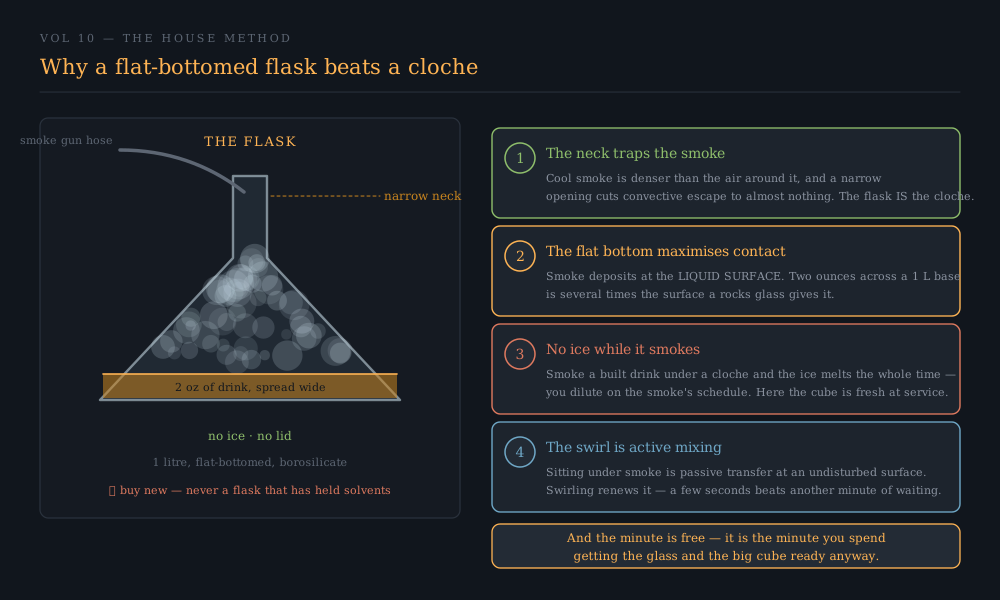
Build the drink completely — bitters, syrup, bourbon, stirred — but without ice. Pour it into a 1 litre flat-bottomed laboratory flask. Start the smoke generator and put the hose into the neck. Leave it about a minute while you prepare the glass and its cube. Then swirl the drink inside the flask and pour it over the ice.
⭐ The flask is doing four things at once, and that is why it beats the cloche.
- The neck traps the smoke. Cool smoke from a gun is denser than the air around it, and a narrow neck cuts the opening through which it can convect and diffuse away to almost nothing. The flask is its own cloche — no lid, no box, no cling film, and nothing to lift off at the wrong moment.
- The flat bottom maximises contact. Vol 10 opened by noting that smoke deposits at the liquid surface. Two ounces of drink spread across the base of a 1 L flask presents several times the surface area it would in a rocks glass — so the same minute of smoke does considerably more work.
- 🔴 The drink is smoked with no ice in it, which is the part most methods get wrong. Smoke a built drink under a cloche and the ice is melting the entire time, so you are diluting on the smoke’s schedule instead of your own. Here the drink sits undiluted, and only meets a fresh, full-size cube at the moment of service. You get the smoke and the dilution control, instead of trading one for the other.
- The swirl is an active mixing step. Leaving liquid under smoke is passive — transfer happens only at the undisturbed surface. Swirling continuously renews that surface and drives the smoke-laden headspace into the liquid, so a few seconds of swirling is worth more than another minute of sitting.
And the timing is free. The minute the flask needs is the minute you spend getting the glass and the big cube ready, so the method costs no extra time at all.
⚠ Use a flask you have not used for chemistry. Borosilicate lab glassware is cheap and food-safe when new; one that has held solvents is not, and no amount of washing changes that. Buy a new one and keep it for the bar.
⚠ Rinse it straight away. Smoke residue is a tar and it will build a brown film on the inside of the glass, which then becomes part of every future drink.
10.1.4.5 Smoked ice
Cold-smoke water, freeze it, and use the cube. Or smoke finished cubes briefly and return them to the freezer.
⭐ The most elegant version of the idea, because the smoke arrives gradually as the ice melts, so the drink gets smokier as it goes rather than starting at maximum and fading. It also decouples the smoking from the making — smoke a batch of ice on a Sunday and every drink that week is a smoked Old Fashioned with no extra work at the bar.
⚠ Clear ice and smoked ice pull against each other: smoking water introduces particulates that will cloud a directionally frozen block (Vol 9). Accept a slightly hazier cube, or smoke the finished clear cubes briefly instead.
10.1.4.6 Smoked syrup, smoked salt, smoked bitters
Smoke the syrup — a shallow dish of simple syrup under a cloche for a few minutes — and you get a smoked drink with complete dose control, because the smoke is now a measured ingredient in a measured volume. This is the most repeatable method in the volume and the least dramatic.
A smoked salt rim on part of the glass, or a few drops of a smoke-forward bitters, do the same job in miniature.
10.1.5 Equipment
- A handheld smoking gun — the Breville/PolyScience type — is the practical tool. It smoulders a small quantity of dust or fine chips with a fan and delivers cool smoke down a hose, which is precisely the “cool, brief, clean” combination the chemistry wants. It is the right first purchase.
- A 1 litre flat-bottomed flask — Florence or Erlenmeyer, borosilicate, bought new and kept for the bar. This is the house vessel and it replaces the cloche entirely: the neck traps the smoke and the base spreads the drink out. Cheap, and it looks superb on a bar with smoke curling in the neck.
- A cloche or a simple lidded box, if you are smoking a built drink instead. A large glass bowl inverted over the drink works.
- A torch for plank work. ⚠ Ventilate, keep it away from the bottle, and remember that high-proof spirit vapour is flammable — this is not a theoretical hazard, and the sensible sequence is to torch the board away from the built drink.
- A cold smoker if you already have one for food, in which case smoked ice and smoked syrup in quantity become trivial.
10.1.6 How long
Start shorter than you think. Timings, as starting points:
Table 2 — Start shorter than you think. Timings, as starting points
| Method | Time | Note |
|---|---|---|
| The flask | ~1 minute, then swirl | The house method. Undiluted drink, big surface, its own cloche |
| Smoke the empty glass | 10–20 s under an inverted glass | The gentlest; a grace note |
| Smoke the finished drink | 10–15 s under a cloche | Easy to overdo; taste before repeating |
| Torched plank | 5–10 s | Hot smoke; the shortest exposure of the five |
| Smoked syrup | 3–5 min on a shallow dish | Dose-controlled afterwards, so a longer smoke is safe |
| Smoked ice | 5–10 min cold smoke before freezing | Effect builds as it melts |
🔴 An over-smoked drink cannot be fixed. There is no addition that removes acrid phenols. The recovery is to make another one, which is a good reason to under-smoke deliberately and smoke again if it wants it.
⚠ Match the smoke to the whiskey. A delicate 86-proof port-finished bourbon (Vol 5) is easily buried; a 100-proof high-rye will take twice as much. And note that a peated Scotch Old Fashioned (Vol 6) is already a smoked drink — smoking it as well is redundant and usually unpleasant.
10.1.7 The house build, complete
Pulling the whole series into one place. This is a preference, stated as one:
- Bitters and syrup into the mixing glass: 3 dashes aromatic, 3 dashes orange, 1/3 oz homemade 1:1 simple syrup — glycerine optional (Vol 3). Stir briefly.
- 2 oz bourbon — Vol 5’s shortlist. Stir to combine. No ice yet.
- Pour the undiluted drink into the 1 litre flask.
- Smoke generator on, hose into the neck. Fill it and leave it about a minute.
- While it smokes, prepare the glass and the large clear cube — the minute is free, because this is the minute you would have spent on the glass anyway.
- Swirl the drink in the flask, then pour it over the cube.
- Express the orange peel, wipe the rim, drop it in. Express the lemon peel, drop it in.
- One real cocktail cherry — Luxardo, Maraska or Fabbri.
Optional, and worth trying once side by side: 2 drops of 20% saline at step 1 (Vol 2). It is not in the 1806 definition and it is not a tradition — it is a modern enhancement that makes the drink rounder without making it sweeter.
The recipe, in the form that syncs to a phone at the bar: Old Fashioned, Smoked and the rest of the shelf: cocktails.
10.1.8 Sources and further reading
- Smoking — the Food site’s deep dive, and its woods page for the full treatment of species selection.
- Literature on wood pyrolysis and smoke composition — guaiacol and syringol as the principal phenolic contributors from lignin.
- Dave Arnold, Liquid Intelligence (2014), for the general treatment of aroma delivery in cocktails.
- Vol 5 for matching smoke intensity to the base; Vol 9 for the ice this drink is built on.
Comments (0)