Clarified Milk Punch · Volume 8
Vol 8 — The Other Milk Punch
Mixed Drinks — Clarified Milk Punch. New Orleans brandy milk punch: opaque, creamy, sweet, drunk at breakfast, and almost entirely unrelated to the drink the rest of this series is about. What it is, where it comes from, and why two completely different drinks ended up with one name.
8.1.1 Two drinks, one name
Ask for a milk punch in New Orleans and you will not get anything resembling Vols 1–7. You will get a cold, opaque, pale drink that looks like a thin milkshake, tastes of brandy and vanilla and nutmeg, and arrives at eleven in the morning.
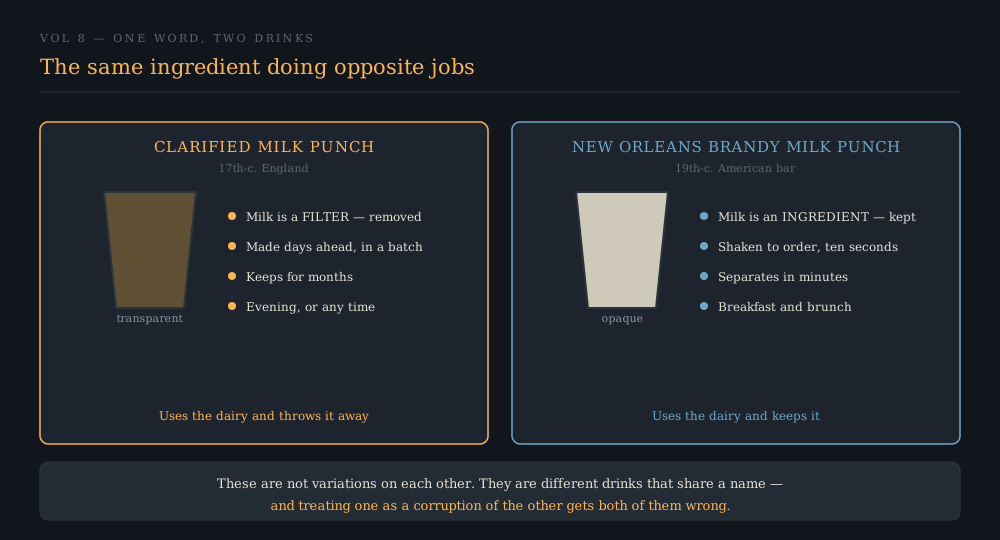
🔴 These are not variations on each other. They are different drinks that share a name, and treating one as a corrupted version of the other — which a lot of writing does, usually in the clarified drink’s favour — gets both of them wrong.
Table 1 — Two drinks, one name
| Clarified milk punch | New Orleans brandy milk punch | |
|---|---|---|
| Appearance | Transparent, pale gold | Opaque, cream-white |
| The milk | A filter, removed | An ingredient, kept |
| Made | Days ahead, in a batch | To order, in seconds |
| Keeps | Months | Minutes |
| Served | Cool, neat, small | Cold, shaken, tall-ish |
| Occasion | Evening, or any time | Breakfast and brunch |
| Origin | 17th-c. England | 19th-c. American bar, via New Orleans |
⭐ The one thing they genuinely share is the historical logic of putting milk in a spirit drink at all — and even that goes in opposite directions. One uses the dairy and throws it away; the other uses the dairy and keeps it.
8.1.2 What it is
The build is simple and it barely varies:
- Brandy — the traditional base, and the reason it is usually called brandy milk punch. Bourbon is the common and entirely legitimate alternative.
- Whole milk, or milk and half-and-half, or cream for a richer version.
- Powdered sugar, or simple syrup.
- Vanilla extract — small, and not optional. It is what makes the drink taste the way people remember.
- Nutmeg, freshly grated over the top.
Shaken hard with ice, strained into a chilled glass, nutmeg on top. Ten seconds’ work.
Frozen brandy milk punch — the same thing spun in a frozen-drink machine — is a New Orleans institution in its own right and is what many bars actually serve.
8.1.3 Where it sits
It belongs to the New Orleans breakfast drinking tradition, which is a real and specific thing rather than a joke: a small group of drinks that the city has long considered appropriate before noon.
- Brandy milk punch — the gentlest of them.
- The Ramos Gin Fizz — gin, cream, citrus, orange flower water, egg white, and a legendarily long shake.
- The Sazerac — rye, Peychaud’s, absinthe rinse; less of a breakfast drink but part of the same civic canon (and the Old Fashioned dive’s Vol 7 covers it as a parallel evolution of the 1806 format).
Brennan’s, Commander’s Palace and Arnaud’s are the addresses most associated with it, and brunch at any of them is where most visitors meet the drink.
⭐ Notice what the three breakfast drinks have in common: dairy or egg, sugar, and a soft edge. These are drinks built to be gentle at an hour when a spirit-forward cocktail would be brutal. That is a coherent design brief, not an accident, and it is worth respecting rather than smirking at.
8.1.4 The family it actually belongs to
The New Orleans drink sits in the dairy-and-spirit family that runs through American and British drinking:
- Eggnog — the same idea with egg added. The collection’s Alton Brown aged eggnog is a close relative and a far more serious drink than its reputation suggests.
- Syllabub — 17th-century English, wine or cider curdled with cream, and a genuine ancestor of the whole category. Note that syllabub deliberately curdles and keeps the curd, which puts it interestingly between the two milk punches.
- The Brandy Alexander, White Russian, and the rest of the creamy-cocktail tradition.
⚠ The 19th-century American bar had “milk punch” on the list as a standard drink, unclarified, made to order — and it is that usage, not the English bottled article, that survives in New Orleans. The two coexisted for a while and the simpler one won the name in America, because it could be made in ten seconds by a bartender with a shaker.
8.1.5 Making it well
It is a three-ingredient drink so the ingredients show.
- Shake it hard and cold. The texture is the whole appeal, and a lazy shake gives a thin, separated drink.
- Do not over-sweeten. Powdered sugar dissolves instantly, which makes it very easy to overdo. Start low.
- Vanilla is a supporting note, not a flavour. A quarter-teaspoon, not a splash.
- Grate the nutmeg fresh, over the glass. Pre-ground nutmeg is dust and tastes of it.
- Chill the glass.
- Make it fresh. It separates within minutes. This is the exact opposite of the drink in Vols 1–7 and it is the clearest illustration of how little the two have in common.
⚠ It is more alcoholic than it tastes, which is true of every drink where dairy and sugar mask the spirit. That is worth remembering about a thing served at brunch.
8.1.6 Why both belong in this dive
Because they share a name, and because somebody who reads about clarified milk punch and then orders one in New Orleans will be baffled otherwise.
But also because the contrast is genuinely instructive. The same ingredient — milk — is doing two opposite jobs. In one it is a reagent that performs a chemical separation and is discarded. In the other it is the body of the drink. Understanding why milk can be either is most of what Vol 3 was about, and seeing it used both ways makes the chemistry land better than either drink does alone.
8.1.7 Sources and further reading
- David Wondrich, Imbibe! (2007) — the 19th-century American bar’s milk punch, and its place on the standard list.
- The Oxford Companion to Spirits & Cocktails, “milk punch.”
- New Orleans brunch literature — Brennan’s own published recipe is the reference version.
- Eggnog, Aged, Alton Brown’s and Syllabub, Lemon in the recipe collection, for the neighbouring drinks.
Comments (0)