Clarified Milk Punch · Volume 10
Vol 10 — Building a First Batch
Mixed Drinks — Clarified Milk Punch. A specific batch to make, a shopping list, a two-day timeline, what each stage should look like, and an honest account of what is still unknown here.
10.1.1 Why a specific recipe rather than a range
Vols 4 and 5 gave ratios and options. Options are useless for a first attempt — what a first attempt needs is one set of numbers that will work, so that the variables can be moved deliberately afterwards.
This is that set. It is deliberately middle-of-the-road: nothing exotic, nothing expensive, everything obtainable, and built to demonstrate the technique clearly rather than to be the best possible punch.
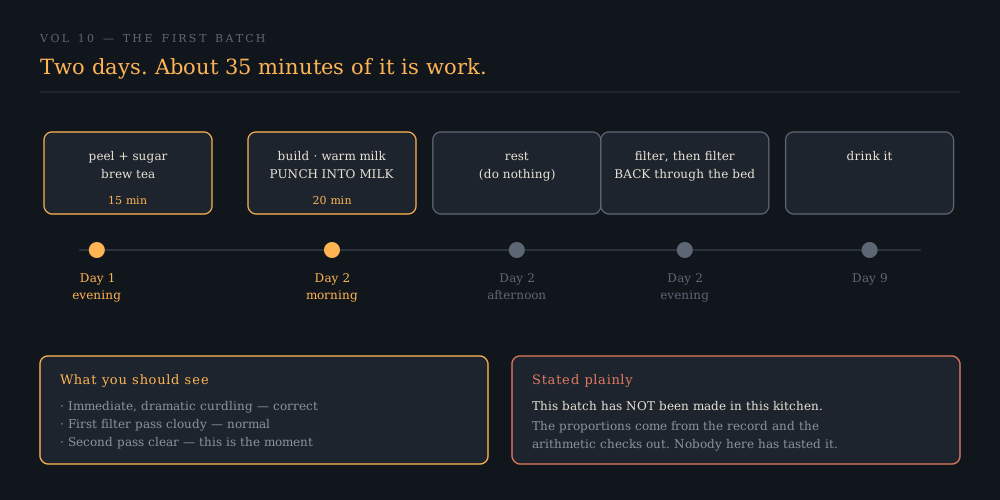
⚠ It has not been made in this kitchen. As Vol 1 said, this dive is written from the record. The proportions are assembled from the historical and modern literature and they are internally consistent — the acid load is sufficient to take the batch below pH 4.6, the milk is within the standard one-to-four-to-six band, and the arithmetic in Vol 7 puts it at roughly 20% ABV — but nobody here has tasted the result. Treat it as a well-researched starting point, not a tested house recipe.
10.1.2 The batch
Yield: roughly 1.4 litres — about two 750 ml bottles, allowing for curd loss.
Table 1 — Yield: roughly 1.4 litres — about two 750 ml bottles, allowing for curd loss.
| Aged rum (or bourbon, or brandy) | 750 ml |
| Strong black tea, brewed double-strength and cooled | 500 ml |
| Lemons | 8 — peel for the oleo, juice for the acid |
| White sugar | 250 g |
| Whole milk | 325 ml |
| Whole nutmeg | 1, for grating |
| Cinnamon stick | 1 |
Why these: rum for aroma that survives (Vol 5); black tea because the tannin feeds the clarification and is not decoration; lemon because it is the reliable acid; whole spice because ground spice clouds what you are about to spend two days clearing.
10.1.3 Timeline
Day 1, evening — 15 minutes’ work
- Peel all 8 lemons in wide strips, avoiding the pith. Toss with the 250 g of sugar. Seal. Leave overnight.
- Brew the tea double-strength. Cool it. Refrigerate.
Day 2, morning — 20 minutes’ work
- Juice the peeled lemons — you want about 250 ml.
- Stir the oleo saccharum until the sugar has dissolved into the drawn-out oil. Strain out the peels.
- Combine rum, tea, oleo saccharum syrup and the cinnamon stick. Stir until fully dissolved. Hold back the lemon juice.
- Warm the milk to about 50 °C in a vessel big enough for everything with headroom.
- Add the lemon juice to the punch. Stir once.
- 🔴 Pour the punch slowly into the milk. Never the other way round (Vol 3). Watch it break.
- One gentle stir. Then leave it alone.
Day 2, afternoon onward — no work, just waiting
- Rest at least an hour; overnight in the fridge is better.
- Filter through damp cheesecloth over a bowl. Do not squeeze. It will run cloudy.
- Pour the cloudy liquid back through the same curd bed. Repeat until clear (Vol 6).
- Bottle, grate nutmeg in, seal, refrigerate.
Day 9 — drink it. It is drinkable at once and better after a week.
10.1.4 What each stage should look like
Table 2 — What each stage should look like
| Stage | What you should see |
|---|---|
| Oleo saccharum, overnight | Peels sitting in a small amount of intensely orange-lemon syrup |
| The moment of pouring | Immediate, dramatic curdling. Alarming. Correct |
| After the rest | A clear layer above, a settled curd below |
| First filter pass | Cloudy, sometimes very. Normal |
| Second pass | Noticeably clear — this is the moment it works |
| In the bottle | Transparent, pale gold, with a faint silkiness when swirled |
⭐ If it looks disastrous somewhere between steps 8 and 11, it is going exactly right. That is the part of the process that makes people stop, and it is the part that cannot be skipped.
10.1.5 Then move one thing at a time
Once a batch has worked, the interesting part starts. Change one variable per batch:
- The spirit — arrack for the historical version, brandy for Franklin’s, gin for something bright and unexpected.
- The tea — Earl Grey, or Lapsang Souchong for smoke.
- The acid — lime with rum; pineapple, which is both acid and aroma.
- The strength — a 100-proof base takes the finished punch from ~20% to ~25% ABV, which is the difference between “refrigerate” and the historical keeping quality (Vol 7).
- The milk quantity — less for a fuller, slightly hazier punch; more for a cleaner, thinner one.
⚠ Two variables at once and you learn nothing. This is a two-day feedback loop, so the discipline pays for itself quickly.
10.1.6 What this dive does not yet know
Stated plainly, because the rest of the internet on this subject does not.
- Nobody here has tasted one. Every judgement in Vols 4, 5 and 10 about proportion and balance comes from the literature.
- The residual whey protein question in Vol 7 is unquantified and the popular sources do not address it.
- The historical-versus-modern milk temperature divergence (Vol 2) — boiling in Franklin’s method, warm in most modern ones — is real, is rarely mentioned, and the difference it makes to the finished drink has not been compared here.
- Whether the tea is doing as much clarification work as Vol 5 claims is a testable proposition — one batch with tea, one without, everything else identical — and it has not been tested.
Those four are the to-do list, and when this dive is revised after an actual batch, that is what should change.
10.1.7 Where the recipes will live
As with everything drinkable on this site, the recipes belong in the kitchen collection, not here — that is the only path that reaches a phone at the bar: the cocktail shelf.
The recipes for this dive: Milk Punch, Clarified (Rum) — the batch above, written out. Milk Punch, Franklin’s 1763 — brandy, boiling milk, and the ~26% ABV that makes the historical keeping claim mean something. Milk Punch, New Orleans Brandy — the other drink, from Vol 8. Ten seconds, opaque, and unrelated except by name. Campari, Milk-Washed — Vol 9’s recommended first attempt. Watch the colour leave the liquid and stain the curds. Piña Colada, Clarified — the modern flagship of the technique.
⚠ None of these has been made here yet — see the caution at the head of this volume. They are the literature, written out carefully, waiting for a batch.
The neighbouring drinks that already existed in the collection are worth knowing too: Eggnog, Aged, Alton Brown’s — the closest relative in the collection, and the same trick of time doing the work. Syllabub, Lemon — 17th-century English, and the interesting case of a drink that curdles on purpose and keeps the curd. Oleo Saccharum, Orange — step 1 of this method, written up on its own.
10.1.8 Sources and further reading
- David Wondrich, Punch (2010).
- Dave Arnold, Liquid Intelligence (2014).
- Benjamin Franklin to James Bowdoin, 11 October 1763 — Massachusetts Historical Society.
- Mary Rockett, 1711 — the earliest surviving written recipe.
- The Old Fashioned — the other dive on this shelf, and the one written from a glass rather than a library.
Comments (0)