Clarified Milk Punch · Volume 2
Vol 2 — The Milk Turn: Behn, Rockett, Franklin and the Bottled Trade
Mixed Drinks — Clarified Milk Punch. Who actually invented it and how thin the evidence is, the earliest surviving recipe, Franklin’s letter, the commercial bottled trade that ran for two centuries, why it vanished, and how it came back.
2.1.1 The attribution, and how much weight it will bear
Almost every account of this drink opens by crediting Aphra Behn — playwright, poet, novelist, and, for a period, a paid intelligence agent for Charles II. She is a wonderful person to have at the head of a drink’s history and the credit may well be correct.
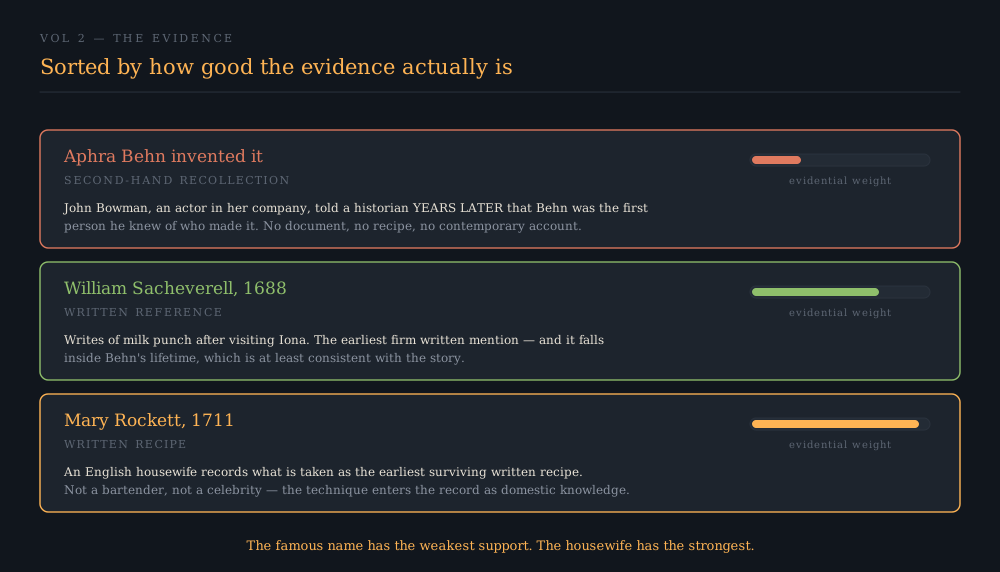
🔴 But look at what the evidence actually is. The attribution comes from John Bowman, an actor who had worked in Behn’s company, who told a historian many years later that Behn was the first person he ever knew or heard of who made “the liquor called Milk Punch.”
That is a recollection, at one remove, recorded long after the fact. It is not a document, a recipe, or a contemporary account. It is exactly the class of evidence the Old Fashioned dive rejects when the Pendennis Club makes the same kind of claim — and consistency requires treating it the same way here.
What is solid:
- 1688 — William Sacheverell writes of milk punch after a visit to the Scottish island of Iona. This is the earliest firm written reference to the drink, and it falls inside Behn’s lifetime, which is at least consistent with the story.
- 1711 — Mary Rockett, an English housewife, records what is generally taken as the earliest surviving written recipe for clarified milk punch. Not a bartender, not a professional, not a celebrity: a woman writing down a household preparation.
⭐ That second fact is the more interesting one and it gets far less attention than the spy. The technique enters the record as domestic knowledge — something made at home, in quantity, and kept. Milk punch is not a bar invention that filtered outward; it is a housekeeping method that bars eventually noticed.
2.1.2 Why anybody bothered
Two problems, and clarification solved both at once. This is the part that makes the whole technique make sense.
Problem one: the spirit was rough. Eighteenth-century rum, arrack and brandy were not the products those words describe today. Distillation was inconsistent, ageing was incidental, and a great deal of what was drunk was harsh, oily and aggressive. Curdled milk strips exactly the compounds responsible — tannins, polyphenols and heavier congeners get caught in the curd and thrown away with it. The drink comes out smoother than the spirit that went into it.
Problem two: nothing kept. There was no refrigeration. A punch made in a bowl was drunk that night or wasted. Clarified milk punch keeps, because clarification removes the fat and most of the protein — the parts that spoil — and leaves a liquid that is acidic, alcoholic and low in nutrients for anything that might want to grow in it.
🔴 So clarification was never about looks. The astonishing clarity that sells the drink on social media today was a by-product of a process aimed at making bad spirit drinkable and making a made-ahead drink survive the summer. It is worth keeping that order straight: the beauty is the side effect, not the purpose.
2.1.3 Franklin’s letter
On 11 October 1763, Benjamin Franklin wrote to James Bowdoin — Boston merchant, natural philosopher, later governor of Massachusetts — taking his leave before returning to Philadelphia, and enclosed a recipe headed “To make Milk Punch.” The two corresponded for forty years, mostly about science.
The recipe is a clarified milk punch in the standard 18th-century shape: brandy, citrus, sugar and water, combined with boiling milk, then strained of the solids. The manuscript survives at the Massachusetts Historical Society, which is a pleasing thing for a drink recipe to be able to say.
⚠ The detail modern accounts skate over is the boiling milk. Franklin’s method, like most of the period, brings the milk to the boil before it meets the acid. Modern practice generally uses milk warm or cold. Both curdle — acid will coagulate casein at any temperature — but heat changes the curd’s texture and speed. It is one of several places where the historical method and the current one have quietly diverged and nobody says so.
Franklin is also, unhelpfully, the reason for a claim that needs care. The archival description of his recipe notes the result could be stored indefinitely at room temperature, and that line has been copied outward into a great many modern articles as though it were general advice. For an 18th-century punch built on high-proof brandy it is a reasonable description of what actually happened. For a modern batch at a fraction of that strength it is not advice to follow. Vol 7 takes this apart properly, because it is the one place in this dive where getting it wrong has consequences beyond a disappointing drink.
2.1.4 Dickens, and the bottled trade
Charles Dickens was an enthusiastic punch-maker and milk punch appears in his letters and his household. He is the most-quoted 19th-century drinker of it, and the association did the drink’s reputation no harm at all.
More consequentially, milk punch became a commercial product. Because it kept and travelled, it could be bottled and sold — which almost no other mixed drink of the era could manage. Bottled milk punch was a going trade in Britain for the better part of two centuries, sold by grocers and wine merchants, and it reached the level of respectability where royal warrants were involved.
⭐ This is the drink’s real historical significance and it is routinely missed. Milk punch is arguably the first commercially successful ready-to-drink cocktail — a bottled, shelf-stable mixed drink, sold to be poured at home, two hundred years before the category was supposedly invented. Every canned cocktail in a supermarket cooler today is working the same problem Mary Rockett solved in 1711.
2.1.5 The disappearance
It goes away in the 20th century, and for once the causes are dull rather than dramatic:
- Refrigeration removed the problem clarification existed to solve. If you can keep things cold, you do not need a drink that survives without it.
- Spirits got better. Consistent industrial distillation and real ageing meant the base no longer needed rescuing from itself.
- Punch itself died (Vol 1), and milk punch went down with the category.
- Prohibition and the wars broke the transmission of technique in the places most likely to have kept it going.
By the mid-20th century “milk punch” in America meant something else entirely — the New Orleans brandy-and-milk breakfast drink, unclarified and opaque, which is a different drink that inherited the name. Vol 8 gives it its own treatment, because it deserves better than being treated as a corruption.
2.1.6 The revival
The recovery runs on the same track as the rest of the cocktail revival: bartenders going back to the 18th- and 19th-century texts and rebuilding from the source. Wondrich’s Punch (2010) is the hinge — it put the whole punch tradition, milk punch included, back into general circulation with the documentation attached.
What made it spread faster than most revived techniques is that it photographs extremely well. A clear amber liquid that ought by rights to be cloudy is an arresting thing, and it travelled through bar culture and then social media on that strength.
⚠ Which brings a cost worth naming. A technique that spreads on how it looks tends to arrive with the mechanism hollowed out. A large share of the milk punch content in circulation repeats the same handful of facts, gets the order of operations wrong, and is confident about shelf life in ways the underlying chemistry does not support. Vols 3, 4 and 7 exist to fix exactly that — what is really happening, how to do it, and how long it actually keeps.
2.1.7 Sources and further reading
- David Wondrich, Punch (2010) — the standard history, and the text that drove the revival.
- Benjamin Franklin to James Bowdoin, 11 October 1763, “To make Milk Punch” — manuscript held by the Massachusetts Historical Society; also in the Founders Online edition of Franklin’s papers.
- Mary Rockett’s milk punch, 1711 — the earliest surviving written recipe; reproduced in several modern collections.
- William Sacheverell’s 1688 account of Iona, for the earliest firm written reference.
- The Oxford Companion to Spirits & Cocktails, “milk punch.”
Comments (0)