Clarified Milk Punch · Volume 7
Vol 7 — Keeping It
Mixed Drinks — Clarified Milk Punch. What actually preserves this drink, an honest look at the “keeps forever at room temperature” claim that is repeated everywhere, how to work out where a given batch sits, and what the sensible storage advice is.
7.1.1 The claim, and why it needs unpicking
Milk punch’s headline selling point — the thing that made it a commercial product for two centuries (Vol 2) — is that it keeps. The Massachusetts Historical Society’s note on Franklin’s 1763 recipe says the strained result could be stored indefinitely at room temperature, and that line has been copied outward into a very large number of modern articles.
🔴 That statement is true about the drink Franklin made. It is not automatically true about the drink you just made, and the difference is not a technicality.
This is the one volume in this dive where being vague would be irresponsible, so it is worth being exact about which factors do the preserving and how to tell where a particular batch lands.
7.1.2 The four things doing the work
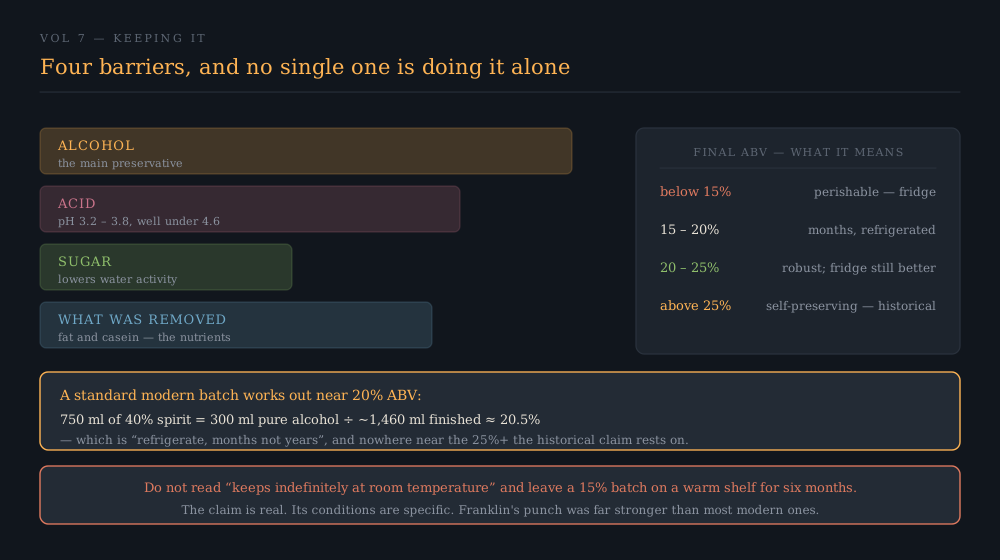
1. Alcohol. The main preservative. Rough working thresholds:
Table 1 — 1. Alcohol. The main preservative. Rough working thresholds
| Final ABV | Behaviour |
|---|---|
| Below ~15% | Not self-preserving. Refrigerate; treat it as perishable |
| 15–20% | Inhibits most spoilage organisms. Refrigerate; months, not years |
| 20–25% | Robust. Cool and dark is genuinely fine; the fridge is still better |
| Above ~25% | Effectively self-preserving. This is the historical territory |
2. Acid. The batch is taken below pH 4.6 to make it curdle at all (Vol 3), and most finish nearer 3.2–3.8. That is a hostile environment on its own, and it is well below the threshold at which Clostridium botulinum can grow — which is the reason this drink does not raise the concern that a low-acid preserve would.
3. Sugar. Lowers water activity. A supporting player, not a lead.
4. What was removed. This is the underrated one. Clarification takes out the fat and most of the protein — the nutrients a spoilage organism would actually want. A clarified punch is a much poorer growth medium than the same punch unclarified, and that is a large part of why the technique preserved anything at all.
7.1.3 Work out your own number
This takes two minutes and it is the difference between following advice and knowing where you stand.
Final ABV ≈ (volume of spirit × its ABV) ÷ final volume of punch.
Worked through Vol 4’s ratio:
- 750 ml of spirit at 40% ABV = 300 ml of pure alcohol
- Total liquid before clarification ≈ 750 + 500 + 250 + 325 ≈ 1,825 ml
- Less about 20% lost to the curd ≈ 1,460 ml finished
- 300 ÷ 1,460 ≈ 20.5% ABV
⭐ So a standard modern batch lands around 20% — squarely in the “refrigerate, months not years” band, and nowhere near the 25%+ that the historical claim rests on. Franklin’s punch, built on a much larger proportion of brandy with far less water, was a considerably stronger drink than the one most people make today from an article quoting him.
If you want the historical keeping quality, you have to build the historical strength: more spirit, less water, or a higher-proof base. A punch made with 100-proof bourbon rather than 80-proof moves the same recipe from roughly 20% to roughly 25%.
7.1.4 Practical storage
- Refrigerate. Always, unless you have deliberately built above 25% and you know it. There is no downside; it costs nothing and removes the question.
- Clean, sealed bottles. Swing-tops or corked wine bottles. Sterilise if you are keeping it for months.
- Fill them full. Less headspace is less oxygen. A part-empty bottle oxidises over months.
- Dark and cool. Light degrades aroma compounds.
- Realistic expectations at ~20% ABV: several months refrigerated, comfortably. Many people report a year and more, and that is plausible — but “plausible” and “guaranteed” are different words.
⭐ It improves for the first week or two, then holds. There is no reason to drink it on day one and a good reason not to.
7.1.5 Knowing when it has turned
Milk punch does not go dramatically bad; it fades and then it sours. Signs, in order of seriousness:
- Haze appearing in a bottle that was clear — usually fines settling out, often harmless. Decant and look again.
- Loss of aroma — oxidation. Not dangerous, just disappointing.
- A vinegary smell — acetic acid bacteria have got in. It has turned. Throw it out.
- Fizz, pressure, or a bulging seal — fermentation. Throw it out, and open it carefully.
- Anything visibly growing — throw it out. Do not “just filter it again.”
⚠ When in doubt, throw it out. A batch costs a bottle of mid-range spirit and an afternoon of waiting. That is not a sum worth gambling against.
7.1.6 Where the honest uncertainty sits
Three things this dive will not claim to have settled:
- Residual whey protein. Vol 3 established that some passes through into the finished punch. How much, and what it means for long-term stability at the low end of the ABV range, is not something the popular literature quantifies and is not something that has been measured here.
- “Indefinitely” has no shelf-life meaning. It is a period description, from a period when the alternative was a drink that spoiled in a day. It should not be read as a modern food-safety statement, and its appearance in modern articles is a copying artefact rather than a finding.
- Nothing here has been tested in this kitchen. As Vol 1 says, this dive is written from the record. The advice above is deliberately conservative for that reason — refrigerate, fill the bottle, know your ABV — because the cautious version of the guidance costs nothing and the confident version would be borrowed rather than earned.
🔴 The one thing worth being firm about: do not read “it keeps forever” and leave a 15% ABV batch on a warm shelf for six months. The claim is real, its conditions are specific, and most modern recipes do not meet them.
7.1.7 Sources and further reading
- Benjamin Franklin to James Bowdoin, 11 October 1763 — Massachusetts Historical Society; the source of the room-temperature claim and of a considerably stronger punch than most modern versions.
- General food-preservation literature on water activity, pH thresholds and alcohol as a preservative.
- The Preservation section on the Food site, and its food-safety page, for the pH 4.6 line in its proper canning context.
- Vol 3 for what was removed and why that matters here.
Comments (0)