Clarified Milk Punch · Volume 3
Vol 3 — What Curdling Actually Does
Mixed Drinks — Clarified Milk Punch. The chemistry, stated exactly: why casein collapses when acid arrives, the two separate mechanisms by which the curd strips a drink, what leaves with the solids and what stays behind, and why the finished punch does not taste of milk.
3.1.1 The one sentence that reframes the whole drink
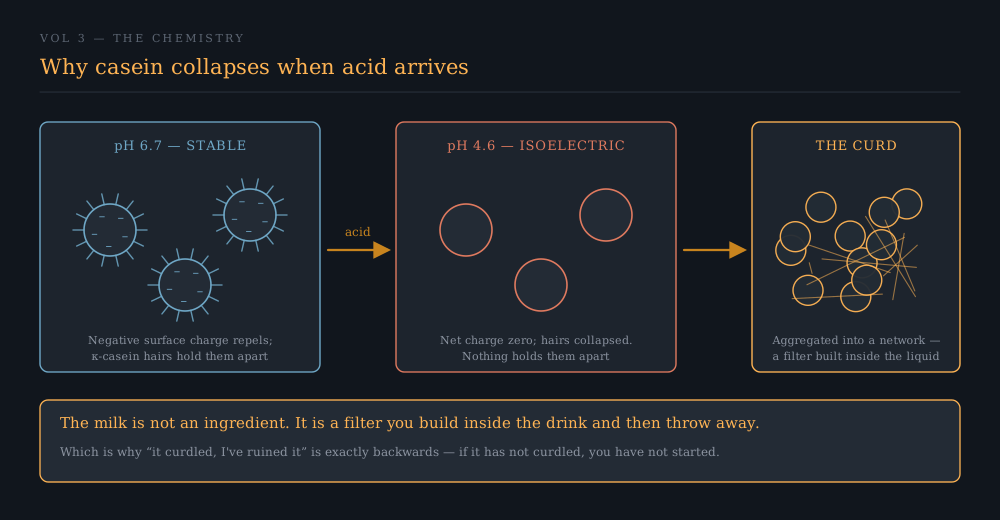
The milk is not an ingredient. It is a filter that you build inside the liquid and then throw away.
Everything else in this volume is an expansion of that. Curdling is not an accident to be tolerated, not a rustic charm, not something that happens despite the recipe — it is the entire technique, deliberately provoked, and the drink is what runs off it.
Which is why the most common reaction to a first attempt — it’s curdled, I’ve ruined it — is exactly backwards. If it has not curdled, you have not started.
3.1.2 Why milk curdles when acid arrives
Milk is a suspension that is deliberately stable. About four-fifths of its protein is casein, carried not as free molecules but as micelles — clusters of protein and calcium phosphate, thousands of times larger than a single protein.
Those micelles stay apart for two reasons:
- Charge. At milk’s natural pH (around 6.7) the micelle surface carries a net negative charge, and like charges repel.
- A hairy layer. κ-casein sits on the outside with a hydrophilic tail projecting into the water, acting as a physical spacer — steric hindrance, in the same way a brush stops two surfaces touching.
Add acid and both defences fail together. Falling pH neutralises the negative surface charge, and the κ-casein layer collapses. Somewhere around pH 4.6 — casein’s isoelectric point, where its net charge is zero — there is nothing left holding the micelles apart. They aggregate, link into a three-dimensional network, and the suspension becomes a solid and a liquid.
⭐ This is precisely the same reaction as fresh cheesemaking — paneer, queso fresco, ricotta by the quick method — and the same one that makes milk split in over-acidic coffee. Cheddar and its relatives go a different route: rennet enzymatically clips the κ-casein hairs off rather than neutralising charge, which is why rennet curd behaves differently. Milk punch is firmly in the acid-set family.
⚠ Heat is a rate control, not a switch. Acid will coagulate casein cold; warmth makes it happen faster and produces a firmer, coarser curd that filters more willingly. This is why 18th-century recipes — Franklin’s among them — call for boiling milk, and why many modern ones do not bother. Both work. They give different curds.
3.1.3 The two mechanisms — and most write-ups only mention one
The curd cleans the drink in two distinct ways, which are often collapsed into a vague “it filters it.”
3.1.3.1 Physical entrapment
The curd is not a flat screen; it is a three-dimensional mesh forming throughout the liquid at once. Anything suspended — particulates, haze, colour bodies — gets caught as the network closes around it. This is depth filtration, and it is why the technique achieves a clarity that pouring the same drink through a filter paper cannot.
3.1.3.2 Chemical binding — the one that does the real work
Proteins bind polyphenols and tannins, tightly and specifically. Proline-rich proteins like casein are particularly good at it.
This is not a theory invented for cocktails. It is the reason milk in tea softens the astringency, the reason a tannic red wine feels smoother with cheese, and the reason casein has been used as a fining agent in winemaking for centuries — added to strip harshness, browning and colour from a wine, then racked off.
Clarified milk punch is casein fining applied to a mixed drink. That framing does more to explain the result than any amount of description: the drink is not merely made clear, it is stripped of the compounds that make a spirit taste rough, which is exactly the problem Vol 2 said the technique was invented to solve.
3.1.4 What leaves, and what stays
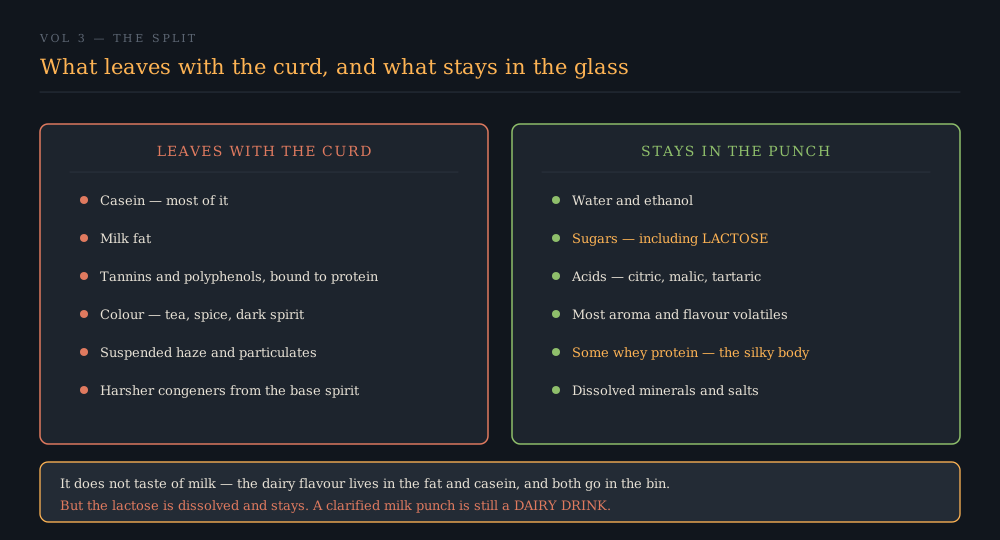
Table 1 — What leaves, and what stays
| Leaves with the curd | Stays in the punch |
|---|---|
| Casein (most of it) | Water and ethanol |
| Milk fat | Sugars — including lactose from the milk |
| Tannins and polyphenols bound to protein | Acids (citric, malic, tartaric) |
| Colour compounds — tea, spice, dark spirit | Most aroma and flavour volatiles |
| Suspended haze and particulates | Some whey protein |
| Harsher congeners from the base spirit | Dissolved minerals and salts |
Two consequences follow, and they are what people find surprising:
⭐ It does not taste of milk. The dairy flavour lives overwhelmingly in the fat and the casein, and both go in the bin. What the milk leaves behind is lactose — mildly sweet — and residual whey protein, which contributes a soft, rounded, faintly silky mouthfeel that is the drink’s signature and the hardest part to describe to somebody who has not had one.
🔴 It is emphatically not lactose-free. The lactose is dissolved, so no amount of filtering removes it, and it is one of the things the technique deliberately keeps. Anybody lactose-intolerant should treat clarified milk punch as a dairy drink, because it is one. The clarity is misleading and it is worth saying out loud.
3.1.5 Why the colour goes
The most striking visual result — a punch built on dark rum, black tea and spice arriving pale gold and perfectly transparent — has a straightforward explanation now that both mechanisms are on the table.
Tea’s colour is polyphenolic. Dark spirits carry colour from wood extractives, themselves largely phenolic. Spices contribute pigments in the same family. All of it is exactly what casein binds. The colour does not fade or break down — it is physically carried out of the liquid attached to protein, and it is visible as the stain on the curds you discard.
⚠ This is also the technique’s main cost. You cannot strip the colour-bearing polyphenols and keep every last thing they came with. A clarified punch is smoother, rounder and more elegant than its unclarified self, and it is also less intense. Something is genuinely traded, and a dive that only lists the gains is selling rather than explaining.
3.1.6 Why “punch into milk” and not the reverse
Every reliable source insists on the direction, and the reason is a consequence of the chemistry above.
Pour the punch into the milk and each arriving splash of acid meets a large excess of milk. The pH falls gradually and evenly across the whole vessel, and casein coagulates in a slow, coherent, well-formed curd — large, open, and easy to separate.
🔴 Pour the milk into the punch and every drop of milk lands in a strongly acidic bath and is shocked past its isoelectric point instantly. The result is a fine, dispersed precipitate rather than a curd network: it filters horribly, blinds a filter almost immediately, and leaves a haze that will not clear.
Same ingredients, same final pH, completely different outcome — and the only variable is which way round you poured. It is the single most consequential instruction in the whole method, and Vol 4 puts it in the right place in the sequence.
3.1.7 Sources and further reading
- Harold McGee, On Food and Cooking — the standard accessible treatment of casein micelles, isoelectric precipitation and acid vs rennet coagulation.
- Dave Arnold, Liquid Intelligence (2014) — clarification in cocktails, including milk clarification and the alternatives compared in Vol 9.
- Standard dairy-science and oenology literature on casein fining and protein–polyphenol binding.
- Vol 4 for the method this chemistry implies; Vol 7 for what it means for shelf life.
Comments (0)